Skip to content

What Are the Visual Arts and Media That Goth Culture Draws From?
Goth culture draws its visual language from a specific, traceable set of sources: Romantic and Gothic Revival painting, German Expressionist silent film, the Pre-Raphaelite Brotherhood, Symbolist and Decadent illustration, Victorian mourning photography, and the album sleeve design of post-punk and 4AD records. It isn't a vague gesture towards "spooky" - it's a visual inheritance with names, dates, and gallery wall labels attached.
Key Takeaways
- Goth's visual roots sit in Romanticism, Gothic Revival art, and the Pre-Raphaelite Brotherhood - all of which predate the goth subculture by over a century.
- German Expressionist silent cinema, particularly Nosferatu (1922) and The Cabinet of Dr. Caligari (1920), shaped goth's visual grammar of shadow, distortion, and dread long before goth music existed.
- Album cover design - especially the work of Peter Saville at Factory Records and Vaughan Oliver at 4AD - turned abstract art history into something you could buy in a record shop and pin to your wall.
- Victorian mourning culture, including memorial photography and memento mori imagery, gave goth its fascination with death as something to be looked at directly, not flinched from.
- Goth and horror overlap heavily but aren't the same thing - horror aims to frighten, goth aims to aestheticise. The Venn diagram is large, but it isn't a circle.
What Visual Art Movements Influenced Goth Culture?
Goth's visual roots sit in Romanticism and the Gothic Revival, two related art movements from the late 18th and 19th centuries that goth absorbed wholesale decades before anyone called the subculture "goth." Romanticism prized emotion, the sublime, and the terror of nature over Enlightenment rationalism, and that's more or less goth's entire mission statement, just two hundred years early.
Henry Fuseli's painting The Nightmare (1781) is as goth as anything produced in 1979 - a woman draped backwards over a bed, an incubus crouched on her chest, a wild-eyed horse pushing through the curtain behind her. Caspar David Friedrich's brooding landscapes, particularly Wanderer above the Sea of Fog (1818), gave goth its taste for a lone figure facing something vast and indifferent. William Blake's visionary, mythologised figures fed the same appetite for the strange and the sublime - Tate Britain's Gothic Nightmares exhibition paired his work with Fuseli's specifically on these grounds, and a growing body of scholarship now treats Blake as a Gothic artist in his own right.
The Pre-Raphaelite Brotherhood, founded in 1848 by Dante Gabriel Rossetti, John Everett Millais, and William Holman Hunt, added the romantic-goth strand directly. Their paintings of doomed women, drowned Ophelias, and tragic medieval love affairs are the direct visual ancestor of romantic goth and Victorian goth fashion today. Look at any romantic goth photoshoot involving flowing hair, a river, and a faraway expression, and you're looking at a Pre-Raphaelite painting with better lighting equipment.
Symbolism and the Decadent movement of the late 19th century pushed things further into the macabre, and they sit close to the broader history of the occult in art. Aubrey Beardsley's stark black-and-white illustrations for Oscar Wilde's Salome (1894) gave goth its appetite for high-contrast, sexually charged, slightly disturbing line work. Belgian Symbolist Fernand Khnopff did similar work in paint - sphinxes, isolation, and dread, rendered with total technical control. He took his own cues from the Pre-Raphaelites, which makes him a useful bridge between the two movements even where the goth connection is more inferred than documented. Memento mori and vanitas painting, the older tradition of skulls and wilting flowers in still life, reminding the viewer they will die, runs underneath all of it. Goth didn't invent the skull motif. It just put it on a T-shirt.
What Films Shaped the Goth Aesthetic?
German Expressionist cinema of the 1920s gave goth its visual grammar of shadow, distortion, and dread, decades before anyone picked up a guitar in a Leeds basement to make post-punk music. The Cabinet of Dr. Caligari (1920), directed by Robert Wiene, used jagged, painted sets and sharp-angled shadows to put the character's mental state directly onto the screen. Nosferatu (1922), F.W. Murnau's unauthorised and much-sued adaptation of Dracula, gave the world Count Orlok - gaunt, rat-faced, and considerably more unsettling than any vampire that came after him. These films established the high-contrast lighting and elongated, predatory silhouette that goth fashion still leans on.
Universal's horror cycle of the 1930s, particularly Dracula (1931) with Bela Lugosi and Frankenstein (1931) with Boris Karloff, took the German Expressionist look and made it commercially mainstream. Hammer Film Productions picked the baton up in Britain from the late 1950s through the 1970s, giving the genre colour, gore, and Christopher Lee's cape work. None of this is incidental to goth - it's foundational. The cape, the candelabra, the crumbling castle: that's all Hammer, repackaged.
Later cinema kept the relationship going rather than starting it from scratch. Tim Burton's visual style - pale skin, exaggerated proportions, gothic suburbia - became a genuine touchstone for a generation of goths who grew up on Edward Scissorhands and The Nightmare Before Christmas. The Hunger (1983), with its languid vampire aristocrats played by David Bowie and Catherine Deneuve, is practically a goth fashion lookbook with a plot attached. The Crow (1994) gave an entire decade its silhouette: trench coat, white face paint, black tear streaks. You can still see it at any goth club on a Saturday night.
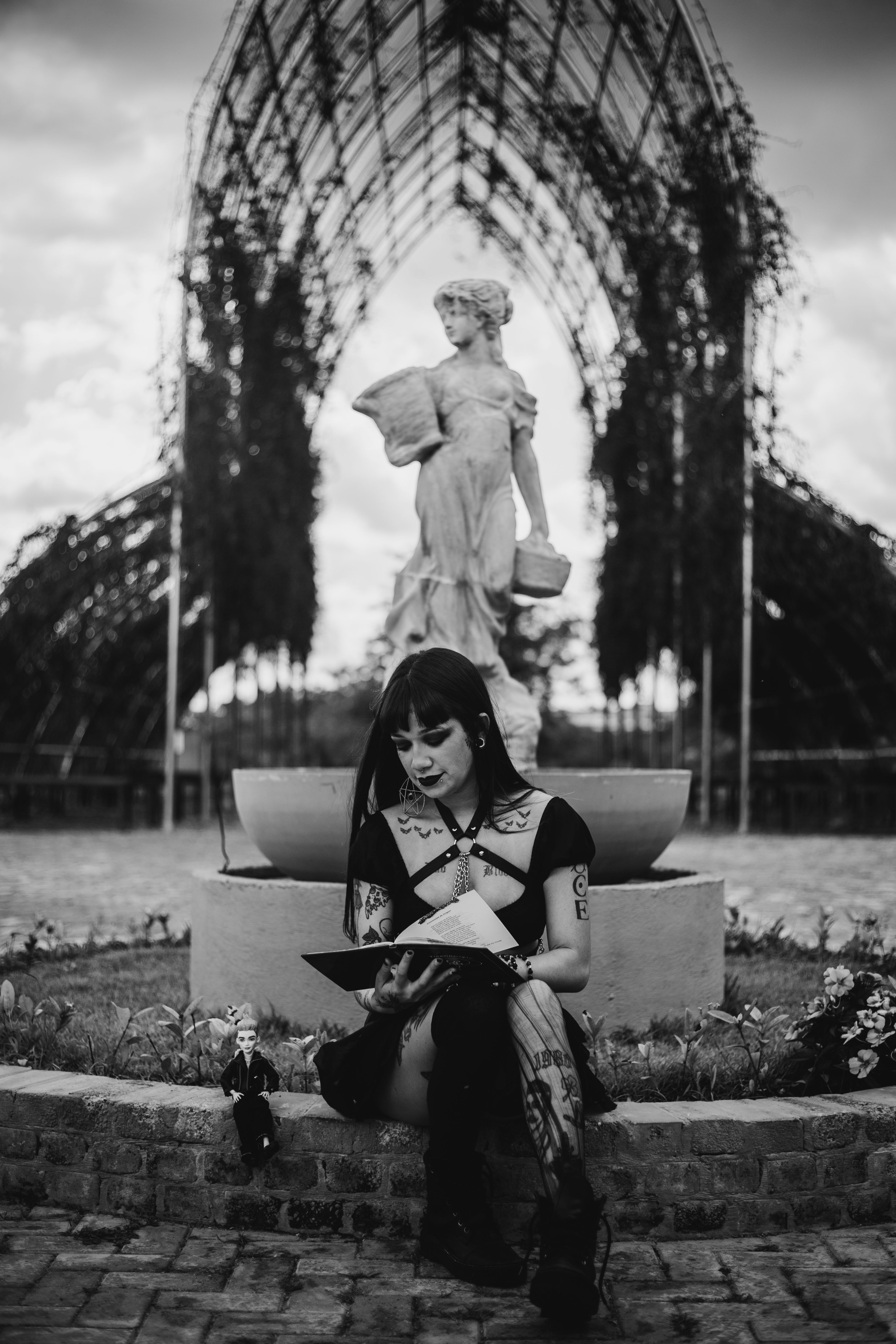
Photo by Marlon Alves from Pexels: https://www.pexels.com/photo/gothic-woman-reading-in-garden-with-statue-34562993/
What Literature and Illustration Influenced Goth Visually?
The Gothic novel gave goth its name, its mood, and a great deal of its imagery before a single black T-shirt was ever printed. Horace Walpole's The Castle of Otranto (1764) is generally credited as the first Gothic novel, and the tradition that followed - Mary Shelley's Frankenstein (1818), Bram Stoker's Dracula (1897), Edgar Allan Poe's short stories - supplied the crumbling architecture, doomed aristocrats, and unreliable narrators that goth still treats as set dressing. The covers and illustrations these books accumulated over a century and a half, all gargoyles, candlelight, and women fainting elegantly into the arms of something undead, did as much visual work as the prose itself.
Victorian mourning culture is goth's most underrated influence, and it deserves more credit than it gets. The Victorians turned death into an aesthetic project: mourning jewellery made from a dead relative's hair, elaborate funeral processions, and memorial photography of the recently deceased, often as a final keepsake for the family. Some of the more elaborate staging details have been exaggerated online over the years, but the underlying practice was real and widespread enough to leave behind a documented genre of its own. This wasn't morbid in the Victorian mind. It was sentimental. Goth inherited that exact framing - death as something to sit with and decorate, not something to look away from.
Edward Gorey deserves his own mention, because his pen-and-ink illustration style - all cross-hatching, Edwardian costume, and dryly murderous children's-book-that-isn't-for-children energy - is one of the most directly inherited visual styles in the whole subculture. The Gashlycrumb Tinies (1963), his alphabet book of children meeting elaborate deaths, reads like it was written specifically to be misquoted on a tote bag. Gorey wasn't goth. Goth didn't exist as a term when he was working. But plenty of goth aesthetics - the striped scarf, the bare tree, the deadpan delivery of something horrible - are Gorey's, borrowed wholesale.
How Did Album Art and Music Packaging Shape the Goth Look?
Album sleeve design turned a century of fine art into something goths could actually own, and that mattered enormously for a subculture built on buying records. Peter Saville's work for Factory Records, including the stark, data-readout cover for Joy Division's Unknown Pleasures (1979), brought a cold, minimalist, design-school sensibility to music packaging that goth absorbed directly. It wasn't horror imagery. It was something colder and more clinical, and it suited the mood perfectly.
Vaughan Oliver's design work for 4AD throughout the 1980s and 1990s did something different but equally important: blurred, romantic, painterly cover art for bands like Cocteau Twins and Dead Can Dance, often shot in collaboration with photographer Nigel Grierson under the name 23 Envelope. This is the visual source of "ethereal goth" as an aesthetic category, more or less in full - soft focus, decay, and beauty held at arm's length.
The sleeves of the genre's founding bands did the rest of the work. Bauhaus's stark black-and-white photography, Siouxsie and the Banshees' theatrical, kabuki-adjacent imagery, and The Cure's increasingly smeared lipstick and hair all gave fans a wardrobe and a face to copy, not just a sound to listen to. A goth in 1981 didn't need a style guide. They had a 12-inch sleeve and a mirror.
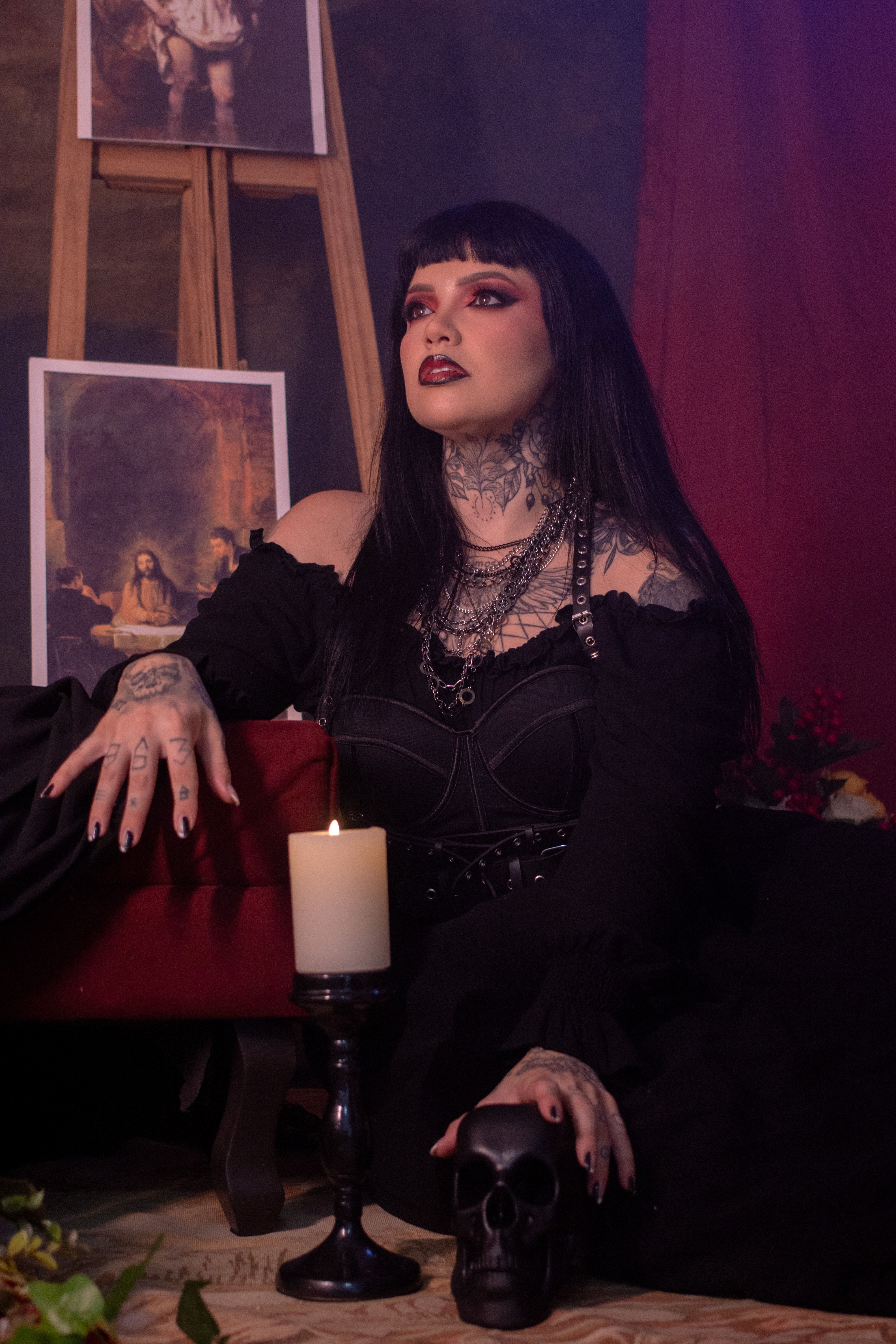
Photo by Fernanda Neitzel from Pexels: https://www.pexels.com/photo/gothic-inspired-portrait-with-dark-aesthetic-38026993/
What Role Does Photography Play in Goth Visual Culture?
Photography sits at both ends of goth's visual history: it documented Victorian death rituals at the start, and it now documents the subculture's own fashion at the other. High-contrast black-and-white portraiture, often with dramatic single-source lighting, has been a goth photographic convention since the post-punk press shots of the early 1980s, and it's still the default setting on most goth Instagram accounts today.
Mourning and memorial photography, discussed above in the context of Victorian death culture, gave goth its comfort with treating a posed, formal image as something emotionally serious rather than something to be embarrassed by. Modern goth fashion photography - elaborate, theatrical, often shot in cemeteries, ruins, or church interiors - is a direct continuation of that instinct: the body as a memento mori, dressed up rather than dressed down.
How Does Goth Visual Culture Compare to Horror as a Genre?
Goth and horror overlap heavily in imagery but serve different purposes, and conflating the two annoys goths for good reason. Horror as a genre exists to frighten. Its visual grammar - jump scares, gore, the monster in the dark - is built around a temporary adrenaline spike. Goth exists to aestheticise. It takes the same imagery (the cemetery, the vampire, the candle, the ruined church) and slows it down into something to be admired rather than survived.
A horror film wants you to flinch. A goth fashion shoot wants you to linger. Both are legitimate. They are not, however, interchangeable, and a goth being told their look is "Halloween-y" has every right to be mildly insulted.
Photo by Paul Lichtblau from Pexels: https://www.pexels.com/photo/black-and-red-samsung-galaxy-smartphone-1790556/
What Visual Sources Does Each Goth Era Draw On?
|
Era / Source |
Approx. Period |
Key Names |
What Goth Took From It |
|---|---|---|---|
|
Romanticism & Gothic Revival |
Late 1700s-1800s |
Fuseli, Friedrich, Blake |
The sublime, the lone doomed figure, nature as threat |
|
Pre-Raphaelite Brotherhood |
1848 onwards |
Rossetti, Millais, Hunt |
Tragic medievalism, flowing hair, doomed romantic women |
|
Symbolism & Decadence |
Late 1800s |
Beardsley, Khnopff |
High-contrast line work, eroticised dread |
|
Victorian mourning culture |
1837-1901 |
N/A (cultural practice) |
Death as sentiment, memorial imagery, jet jewellery |
|
German Expressionist film |
1920s |
Wiene, Murnau |
Shadow, distortion, the predatory silhouette |
|
Universal & Hammer horror |
1930s-1970s |
Lugosi, Karloff, Lee |
The cape, the castle, mainstream horror iconography |
|
Post-punk album design |
Late 1970s-80s |
Peter Saville |
Cold minimalism, design-led sleeve art |
|
4AD design house style |
1980s-90s |
Vaughan Oliver, Nigel Grierson |
Blurred, painterly, "ethereal goth" imagery |
|
Gorey-style illustration |
1950s onwards |
Edward Gorey |
Deadpan death, Edwardian costume, cross-hatching |
How Can You Spot These Influences Today?
You can spot most of goth's visual sources by asking where a specific element of an outfit, photo, or interior actually comes from, rather than treating the whole look as one undifferentiated "dark aesthetic." A lace mourning veil and jet jewellery point to Victorian mourning culture. A flowing dress shot in soft focus near a ruin points to the Pre-Raphaelites and 4AD's design legacy in roughly equal measure. Sharp eyeliner, stark black-and-white photography, and a deliberately blank expression point straight back to German Expressionist cinema.
Interiors work the same way. A typical goth household with heavy velvet curtains, taxidermy, and gilt-framed portraiture is pulling from Gothic Revival domestic style. One with cold concrete, minimal furniture, and a single dramatic light source is closer to the Factory Records school of cold, clinical goth minimalism. Neither is more authentic than the other. They're just citing different sources.
FAQ
What is the connection between goth and German Expressionism? German Expressionist films of the 1920s, particularly The Cabinet of Dr. Caligari and Nosferatu, established the visual grammar of shadow, distortion, and the gaunt, predatory figure that goth fashion and photography still rely on. The connection is direct and well documented in film and subculture scholarship, not a loose aesthetic coincidence.
Did goth culture come from horror films? Not exclusively. Horror cinema, particularly German Expressionism and the Universal and Hammer horror cycles, is one major visual source, but goth also draws heavily on Romantic and Pre-Raphaelite painting, Gothic literature, Victorian mourning culture, and post-punk album design. Treating horror films as the sole origin point flattens a much wider set of influences.
What is Gothic Revival art? Gothic Revival is a 19th-century art and architecture movement that consciously imitated medieval Gothic styles, including pointed arches, dramatic verticality, and ornate detail. It influenced goth's taste for cathedral imagery, mock-medieval fashion silhouettes, and the broader idea that the medieval past is a source of beauty rather than backwardness.
Is Edward Gorey goth? Edward Gorey wasn't part of the goth subculture and predates the term's use in this context. His illustration style, however, has been adopted so thoroughly by goth visual culture - particularly his cross-hatched Edwardian costume work and deadpan treatment of death - that he functions as a direct visual ancestor even without ever claiming the label himself.
What is the connection between goth and the Pre-Raphaelites? The Pre-Raphaelite Brotherhood's paintings of tragic, doomed women in flowing medieval dress are the direct visual source of romantic goth and Victorian goth fashion. The soft-focus, river-and-ruins photoshoot common in modern goth fashion media is essentially a restaging of Pre-Raphaelite composition with a camera instead of a paintbrush.
Why did Victorian mourning culture influence goth so heavily? Victorian mourning culture treated death as something to decorate and sit with rather than avoid, through practices like memorial photography, mourning jewellery, and elaborate funeral ritual. Goth inherited that same framing almost unchanged: death as an aesthetic and emotional subject rather than something to flinch from.
What's the difference between goth imagery and horror imagery? Horror imagery exists to frighten through shock, darkness as concealment, and tension released via a scare. Goth imagery uses many of the same visual elements - cemeteries, vampires, candlelight - but slows them down into something to be admired and composed rather than something that startles. The two share sources but serve different purposes.
Did album cover design actually shape how goths dressed? Yes, directly. Design work from Peter Saville at Factory Records and Vaughan Oliver at 4AD gave fans a physical, ownable piece of visual art tied to the music they listened to, and goths of the late 1970s and 1980s drew their wardrobe and styling cues from those sleeves as much as from the bands' live performances.
Whether your taste runs to Pre-Raphaelite romance or German Expressionist shadow, our gothic art prints, gothic earrings, and iron-on patches are an easy way to bring a bit of that visual history into your own wardrobe.