Skip to content

What Are the Different Sub-genres Within Goth Culture?
Goth culture contains more than a dozen recognised sub-genres, each with its own distinct music, fashion, and aesthetic - ranging from the post-punk origins of traditional goth in the 1980s to modern internet-born styles like nu goth and pastel goth. While all goth sub-genres share an affinity for darkness, the macabre, and non-conformity, they differ significantly in their musical influences, visual language, and cultural references. (Yes, there is a right and wrong answer to "what kind of goth are you?" - and yes, some goths will tell you about it at length.)
Key Takeaways
- Goth culture began as a post-punk music scene in the UK in the late 1970s and early 1980s, centred on bands like Bauhaus, Siouxsie and the Banshees, and The Cure.
- There are at least 14 widely recognised goth sub-genres, spanning music-led styles (trad goth, death rock, cyber goth) and aesthetics-led styles (Victorian goth, nu goth, pastel goth).
- Sub-genres are not mutually exclusive - many goths blend elements from multiple styles.
- The oldest sub-genre is traditional goth (trad goth), which dates to 1979.
- New sub-genres continue to emerge, often through social media communities.
What Is Goth Culture?
Goth is a subculture that emerged from the post-punk music scene in the United Kingdom in the late 1970s. It is defined by a fascination with darkness, death, romanticism, and the macabre, expressed through music, fashion, literature, and art. The term "gothic" was applied to the early scene by music journalists describing the dark, atmospheric sound of bands like Bauhaus and Joy Division. Over the following decades, goth evolved far beyond its musical origins into a broad cultural identity with numerous distinct sub-genres - each one convinced, to varying degrees, that it is the most authentically goth.
The 14 Main Goth Sub-genres Explained
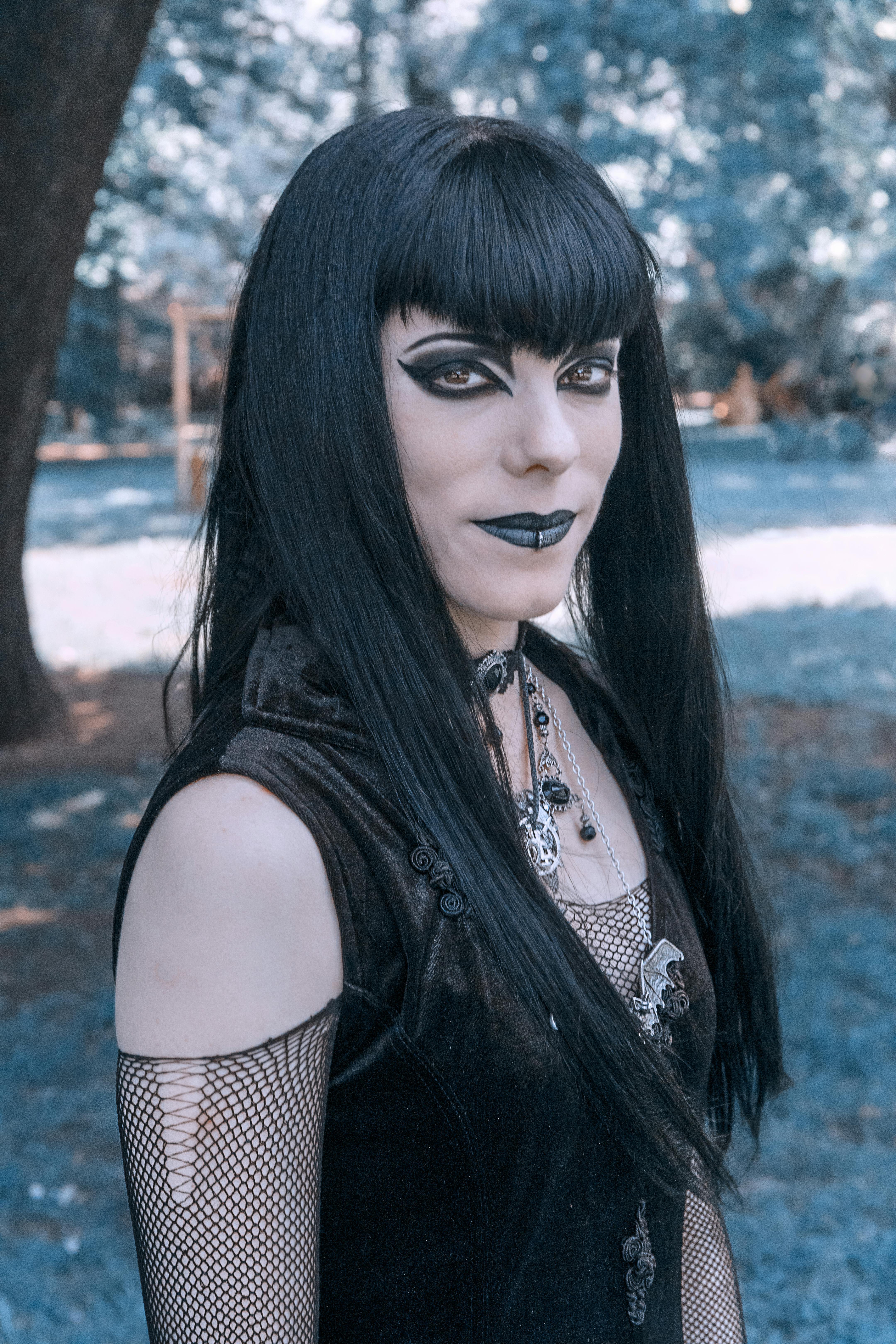
Photo by Antonio Friedemann from Pexels: https://www.pexels.com/photo/woman-with-black-make-up-and-attire-5434266/
1. Traditional Goth (Trad Goth)
Traditional goth - often called trad goth - is the original and oldest goth sub-genre, emerging in the UK between 1979 and 1983. It is the closest to goth's post-punk roots and is considered the foundation from which all other sub-genres developed.
Music: Bauhaus, Siouxsie and the Banshees, The Cure, Joy Division, Sisters of Mercy, The Mission, Fields of the Nephilim.
Aesthetic: Black teased or backcombed hair, heavy black eyeliner, pale skin, fishnet stockings, band T-shirts, leather jackets, pointed boots. Both masculine and feminine styles are common and often overlap.
Key characteristics: Strong emphasis on the original goth music canon. Trad goths are the scene's historians and gatekeepers - they know every B-side and they will tell you which newer sub-genres don't count. This is not always endearing, but they're not entirely wrong.
2. Romantic Goth
Romantic goth draws on Gothic literature and the Romantic literary movement of the 18th and 19th centuries, blending dark aesthetics with themes of love, tragedy, and beauty. Authors like Edgar Allan Poe, Mary Shelley, and Anne Rice are central cultural touchstones - basically, if it involves doomed love and someone coughing elegantly into a handkerchief, it fits.
Music: Lycia, Black Tape for a Blue Girl, Faith and the Muse, Mephisto Walz.
Aesthetic: Flowing lace, velvet, deep reds and purples alongside black, antique jewellery, cameos, corseted silhouettes. More overtly romantic and sensual than trad goth.
Key characteristics: Strong literary and artistic influences. Often overlaps with Victorian goth and is one of the most visually elaborate sub-genres.
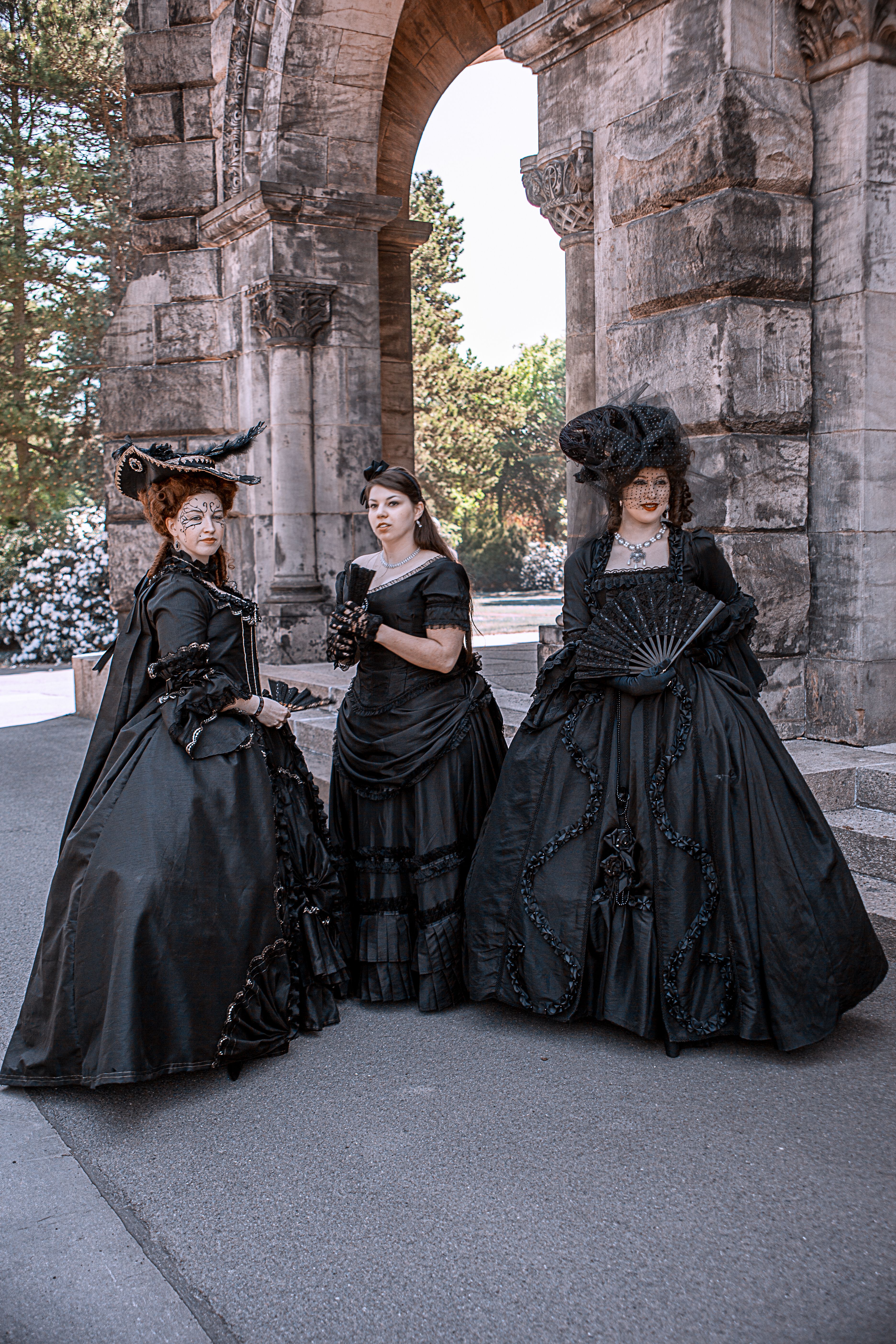
Photo by Antonio Friedemann from Pexels: https://www.pexels.com/photo/a-three-women-wearing-black-gown-5673261/
3. Victorian Goth
Victorian goth applies the goth aesthetic specifically to the fashions of the Victorian era (1837-1901), drawing heavily on 19th-century mourning dress, funeral culture, and the Gothic Revival architectural and literary movement of the period.
Music: Shared largely with romantic goth - dark, atmospheric, and orchestral.
Aesthetic: Corsets, bustle skirts, top hats, mourning veils, pocket watches, high collars, black lace gloves, and jet jewellery. Historically accurate Victorian silhouettes are a priority.
Key characteristics: Often overlaps with steampunk goth. Mourning and memorial culture - flowers pressed in books, memento mori imagery - is a distinguishing aesthetic interest. The Victorians were, it turns out, extremely goth already.
4. Death Rock
Death rock is a sub-genre that developed independently on the West Coast of the United States in the late 1970s and early 1980s, running parallel to the UK goth scene. It incorporates horror imagery, theatrical performance, and punk aggression more explicitly than UK trad goth.
Music: Christian Death, 45 Grave, Kommunity FK, Alien Sex Fiend, Cinema Strange.
Aesthetic: Theatrical horror makeup, ripped fishnet, wild back-combed hair, horror film references, band patches.
Key characteristics: Death rock is often considered a distinct parallel movement to UK goth rather than a sub-genre of it. The two scenes influenced each other significantly and share considerable musical overlap - think of them as goth cousins who grew up on different continents and have very strong opinions about who came up with the look first.
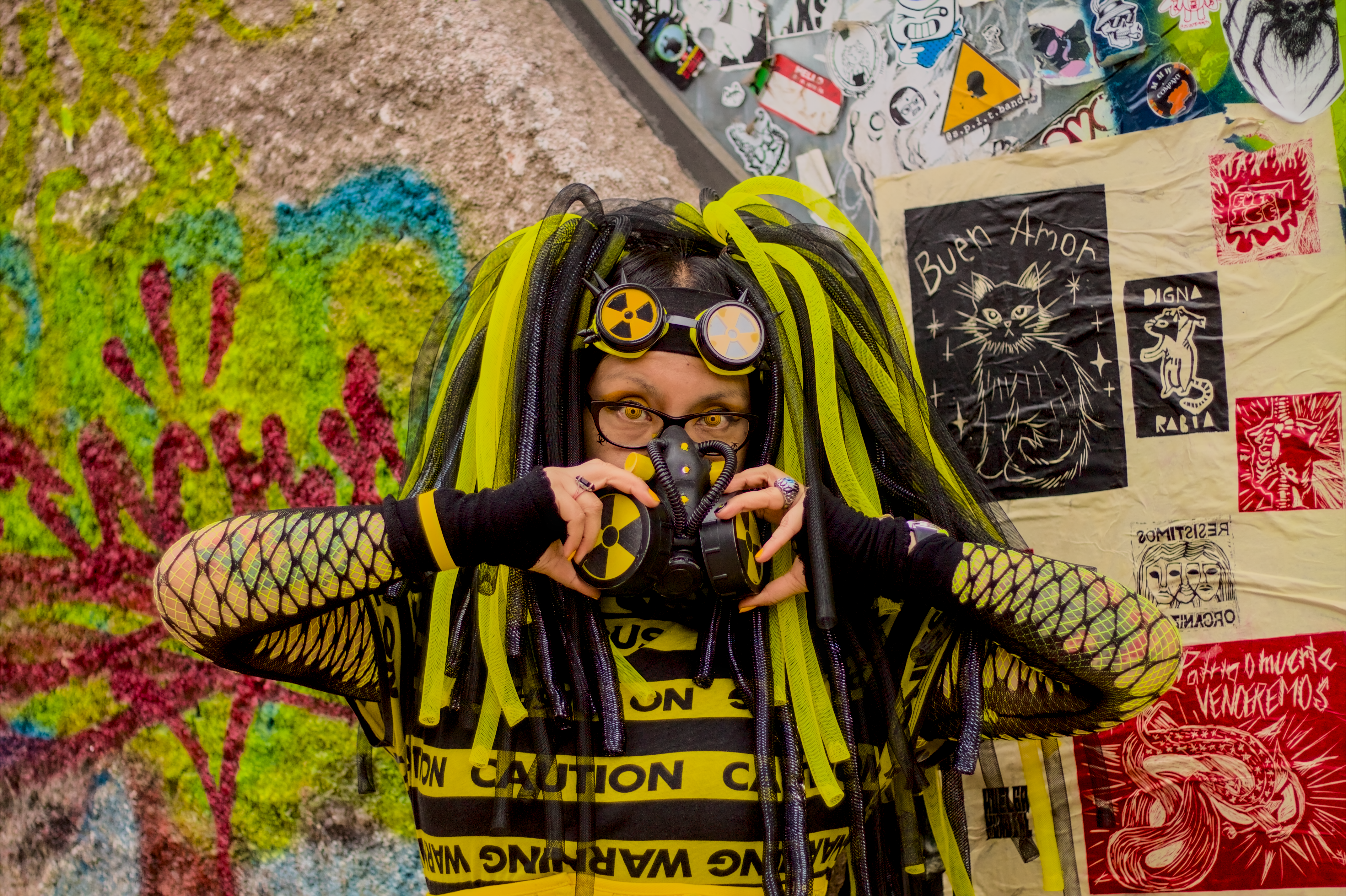
Photo by Guelang Morgan Seyer from Pexels: https://www.pexels.com/photo/colorful-urban-street-art-and-cyberpunk-costume-36738967/
5. Cyber Goth
Cyber goth emerged in the mid-to-late 1990s at the intersection of the goth and industrial music scenes, incorporating rave culture, futurism, and cyberpunk aesthetics. It is one of the most visually distinctive goth sub-genres - you will not miss a cyber goth at a bus stop.
Music: EBM (Electronic Body Music), industrial, aggrotech, and dark electro - including bands like Combichrist, VNV Nation, Covenant, and Aesthetic Perfection.
Aesthetic: Neon synthetic dreadlocks (called "falls" or "cyberlox"), UV-reactive accessories, gas masks, platform boots (especially New Rock or Demonia), black combined with neon green, yellow, or orange. Futuristic and dystopian visual language.
Key characteristics: One of the loudest and most high-energy goth sub-genres aesthetically. Cyber goths often attend industrial and EBM club nights rather than traditional goth clubs - the music is faster, the boots are taller, and the hair is louder.
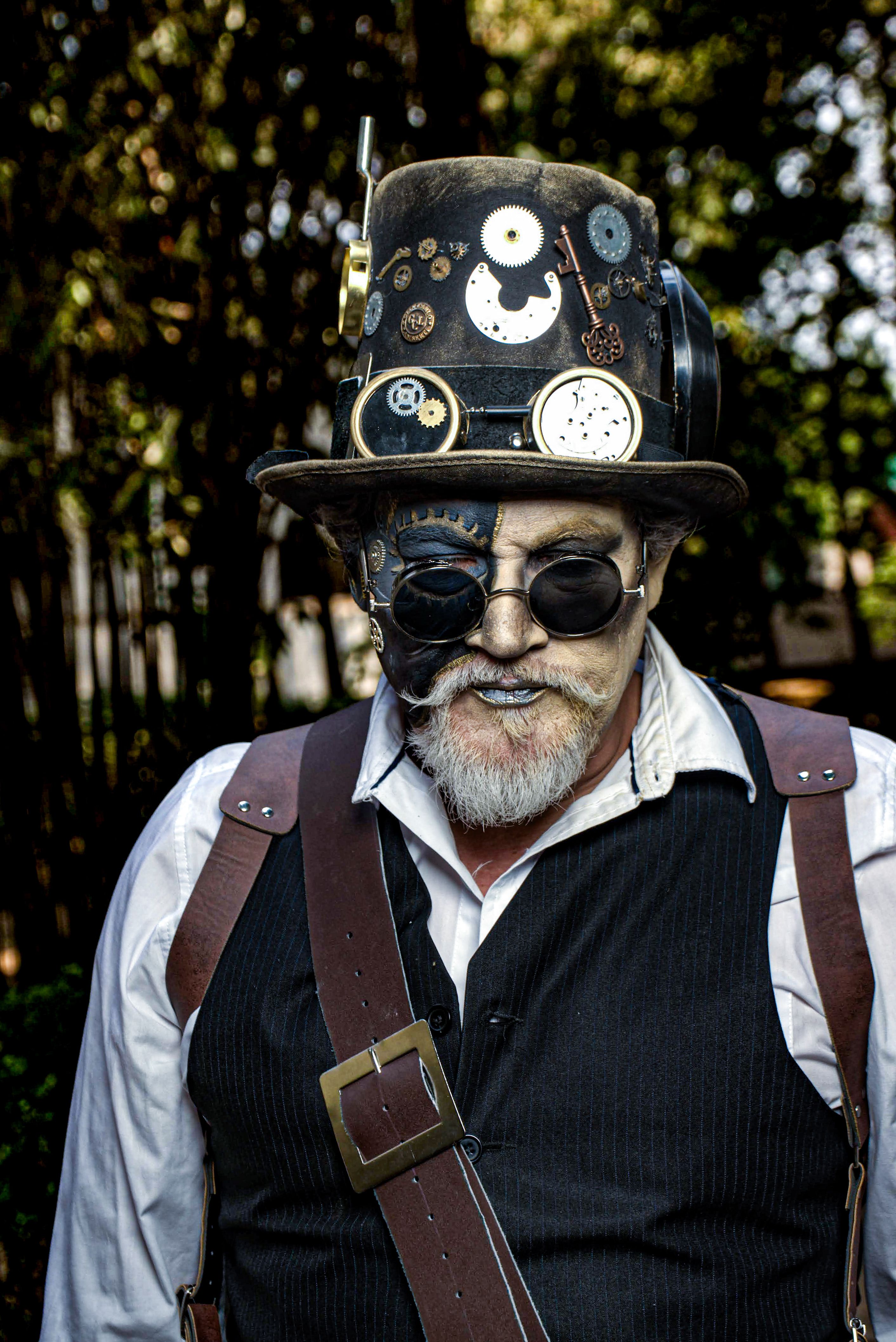
Photo by Eduardo González from Pexels: https://www.pexels.com/photo/steampunk-style-man-in-hat-and-sunglasses-22679079/
6. Steampunk Goth
Steampunk goth combines the goth aesthetic with steampunk - a genre rooted in Victorian-era industrial science fiction, imagining an alternate history of steam-powered technology. It sits at the overlap of goth subculture and the broader steampunk community.
Music: Abney Park, Vernian Process, The Men That Will Not Be Blamed for Nothing.
Aesthetic: Victorian silhouettes combined with mechanical embellishments - gears, cogs, clock parts, brass goggles, corsets, waistcoats, pocket watches, modified gadgetry.
Key characteristics: More science fiction-oriented than Victorian goth. The steampunk community is large enough to exist independently of goth culture, but the overlap is significant. If you've ever looked at a functioning pocket watch and thought "needs more brass and existential dread," steampunk goth is probably for you.
7. Gothic Lolita (Elegant Gothic Lolita / EGL)
Gothic lolita - sometimes abbreviated as GothLoli or EGL (Elegant Gothic Lolita) - originated in Japan in the 1990s, blending Western Gothic aesthetics with the Japanese Lolita fashion movement. It is one of the most codified and rule-governed goth sub-genres, with strict silhouette standards.
Music: Visual Kei bands such as Malice Mizer, Moi dix Mois, and Dir en grey are closely associated with the scene.
Aesthetic: Bell-shaped skirts with petticoats, lace trim, knee-high socks, Mary Jane shoes, lace headdresses (called "katsura" or "bonnets"), doll-like makeup. Black and white are the dominant colours in gothic lolita specifically, distinguishing it from other Lolita sub-styles.
Key characteristics: More deliberately "cute" than Western goth styles. The Lolita community places strong emphasis on modesty and craftsmanship of clothing. EGL has its own extensive internal sub-style hierarchy - if you thought goth had a lot of sub-genres, Lolita fashion will humble you.
8. Nu Goth
Nu goth is a 2010s sub-genre that emerged largely through social media platforms including Tumblr and Instagram. It reinterprets goth aesthetics through a modern, minimalist lens with heavy influences from occultism, witchcraft, and New Age spirituality.
Music: Crystal Castles, White Ring, Chelsea Wolfe, Zola Jesus, Salem.
Aesthetic: All-black minimalist outfits, occult symbols (pentagrams, moons, Eyes of Horus), wide-brimmed hats, chunky platform shoes, geometric or celestial jewellery. Less theatrical than trad goth, more understated.
Key characteristics: Nu goth is frequently criticised by older goths for its loose relationship with goth music - and those critics are not entirely wrong. It is, however, one of the most commercially accessible and widely visible goth sub-genres today, and it has introduced a lot of people to the broader scene. Trad goths are not required to say thank you, but they might consider it.
9. Pastel Goth
Pastel goth - also known as "Creepy Cute" - emerged on Tumblr around 2012, combining goth imagery and dark themes with soft pastel colours borrowed from kawaii (Japanese cute) culture. It is exactly what it sounds like: skeletons in lavender.
Music: Witch house, dream pop, and lo-fi dark pop.
Aesthetic: Pastel pinks, purples, and blues alongside black; skull and occult motifs in soft tones; galaxy prints; cat ears; creepy-cute character prints; platform shoes.
Key characteristics: One of the most internet-native goth sub-genres. The deliberate juxtaposition of "cute" and "creepy" is its defining feature. Closely related to the broader "soft goth" aesthetic.
10. Health Goth
Health goth emerged around 2013 as a tongue-in-cheek but genuine aesthetic movement applying goth sensibilities to athletic and sportswear. It originated from a Facebook group and gained significant coverage in fashion media. The fact that it exists is either a sign of goth culture's remarkable adaptability or a sign that the 2010s were a strange time - possibly both.
Music: Industrial, body music, hard techno.
Aesthetic: All-black athletic wear, technical fabrics, sportswear brands (particularly Nike and Adidas in black), techwear influences, monochrome gym wear.
Key characteristics: One of the most commercially influenced goth sub-genres. Closely related to techwear and normcore aesthetics filtered through a goth lens. The aesthetic is: you would train for the apocalypse, but only if the kit was all-black.
11. Medieval Goth
Medieval goth draws on the aesthetics of the European Middle Ages - feudal fashion, monasticism, heraldry, and dark folklore - applied through a goth lens.
Music: Dark folk and medieval-influenced music such as Dead Can Dance, Heilung, Omnia, and Faun.
Aesthetic: Flowing robes, chainmail details, fur trim, leather armour aesthetics, Celtic knotwork jewellery, earthy tones (deep greens, browns, and burgundy) combined with black.
Key characteristics: Often overlaps significantly with the dark folk, pagan, and Viking subcultures. Medieval goths may attend LARP (live-action roleplay) events or Renaissance fairs. Whether this makes them the most committed or most chaotic members of the goth scene is a matter of ongoing debate.
12. Ethereal / Fairy Goth
Ethereal goth - sometimes called fairy goth - emphasises a soft, ghostly, otherworldly aesthetic. It draws on Pre-Raphaelite art, mythology, and nature imagery interpreted through a dark filter.
Music: Cocteau Twins, This Mortal Coil, Collide, darkwave ambient.
Aesthetic: Flowing diaphanous fabrics, pale or silver tones alongside black, floral and nature motifs, delicate jewellery, soft and dreamy makeup. More feminine and soft-edged than most goth sub-genres.
Key characteristics: Strong connections to darkwave and the 4AD record label's aesthetic output of the 1980s-90s. Often overlaps with romantic goth. This is goth for people who want to look like a beautiful ghost, which is a perfectly valid aspiration.
13. Bubble Goth
Bubble goth was coined by Estonian singer Kerli Koiv around 2010 to describe a style that deliberately combines elements considered opposite - light and dark, cute and creepy, sweet and disturbing.
Music: Dark pop, dream pop with dark production.
Aesthetic: Black and white with bold graphic contrast, balloon or bubble-inspired shapes, theatrical makeup, fantastical accessories.
Key characteristics: More directly tied to a single artist's vision than most goth sub-genres, which is either a strength or a limitation depending on how you feel about Kerli. Overlaps with pastel goth and avant-garde fashion.
14. Corporate Goth / Office Goth
Corporate goth - sometimes called "office goth" - describes the practical adaptation of goth aesthetics to professional work environments, becoming notably popular as a social media aesthetic from around 2020 onwards. It answers the question nobody thought to ask: what if the grim reaper worked in compliance?
Music: No specific music genre association - the soundtrack is presumably whatever is playing in the lift.
Aesthetic: Dark tailoring, black or charcoal suits and blazers, subtle occult jewellery, dark florals, deep plum and forest green combined with black, structured silhouettes.
Key characteristics: More lifestyle and fashion-framing concept than a fully developed subculture. Resonates strongly with goths who maintain dark aesthetics in professional settings without necessarily broadcasting it.
How Do the Major Goth Sub-genres Compare?
|
Sub-genre |
Origin |
Music Focus |
Aesthetic Focus |
Age |
|
Traditional Goth |
UK, c.1979 |
Post-punk, gothic rock |
Dark, minimal, band-led |
Oldest |
|
Death Rock |
USA, c.1979 |
Horror punk, post-punk |
Theatrical horror |
Oldest (parallel) |
|
Romantic Goth |
UK/USA, 1980s |
Darkwave, 4AD |
Gothic literature, lace, velvet |
Early |
|
Victorian Goth |
UK/USA, 1980s-90s |
Orchestral, atmospheric |
Victorian mourning fashion |
Mid |
|
Cyber Goth |
UK/Europe, 1990s |
EBM, industrial |
Futuristic, neon |
Mid |
|
Gothic Lolita |
Japan, 1990s |
Visual Kei |
Doll-like, bell skirts |
Mid |
|
Steampunk Goth |
UK/USA, 2000s |
Steampunk folk |
Victorian sci-fi |
Mid |
|
Nu Goth |
USA, 2010s |
Witch house, dark pop |
Occult minimalism |
Recent |
|
Pastel Goth |
Internet, 2012 |
Witch house, dream pop |
Kawaii + creepy |
Recent |
|
Health Goth |
Internet, 2013 |
Industrial, techno |
Dark athletic wear |
Recent |
What Is the Difference Between Goth and Emo?
Goth and emo are distinct subcultures with different musical and cultural origins - a fact that goths will, if given the opportunity, explain to you firmly. Goth emerged from post-punk in the UK in the late 1970s and is primarily defined by gothic rock music and an aesthetic rooted in Victorian imagery, horror, and the macabre. Emo (short for "emotional hardcore") emerged from the American hardcore punk scene in the mid-1980s and is characterised by emotionally confessional music, with mainstream visibility peaking in the 2000s with bands like My Chemical Romance, Fall Out Boy, and Paramore.
The confusion between the two is common because both communities favour dark clothing and both are broadly counter-cultural, and the two scenes have blended further in recent internet-born hybrids like the e-kid look. The musical traditions, cultural references, and historical origins are, however, entirely separate. Calling a goth "emo" is technically incorrect and may be received accordingly.
How to Tell Which Type of Goth You Are
The clearest way to identify which goth sub-genre fits you is to start with the music. Goth began as a music-led movement, and most sub-genres are rooted in specific sonic traditions. Ask yourself:
- What music do you listen to? If you gravitate toward Bauhaus and Sisters of Mercy, trad goth is your anchor. If you prefer EBM and industrial, cyber goth may fit better. If you lean toward witch house and dark pop, nu goth or pastel goth are closer.
- What aesthetic references resonate most? Victorian mourning culture points to Victorian goth. Futurism and cyberpunk point to cyber goth. Minimalism and occult symbolism points to nu goth.
- What is your relationship to the music history of goth? Trad goths tend to value knowledge of the original scene highly. More aesthetics-led sub-genres are less concerned with musical heritage - which is fine, but worth knowing about yourself before you walk into a goth club and confidently mention your favourite TikTok sound.
Many goths blend elements from multiple sub-genres, and there is no requirement to pick one exclusively.
FAQ
What is the oldest goth sub-genre? Traditional goth (trad goth) is the oldest sub-genre, dating to the post-punk scene that emerged in the UK around 1979. The bands Bauhaus, Joy Division, and Siouxsie and the Banshees are considered the founding acts. Death rock developed simultaneously but independently on the US West Coast.
How many goth sub-genres are there? There is no definitive official count, but most community-recognised lists identify between 12 and 20 distinct goth sub-genres. The number continues to grow as new styles emerge, particularly through social media communities. Anyone claiming the list is complete is probably a trad goth.
What is the most popular goth sub-genre? Nu goth is currently the most widely visible goth sub-genre due to its social media presence, though trad goth remains the most culturally significant to the core goth community. Gothic lolita is the most popular sub-genre in East Asia.
Is steampunk a type of goth? Steampunk has its own distinct community and is not exclusively a goth sub-genre. However, steampunk goth is a recognised crossover style that applies goth aesthetics to the steampunk framework. Many participants in both scenes identify with both communities.
Are there male-identifying goth sub-genres? Goth culture is notably androgynous across most sub-genres, and gender-nonconforming fashion has been part of the scene since trad goth's earliest days. Most sub-genres are not gender-coded, though gothic lolita in its original Japanese form is predominantly worn by women. Corporate goth and trad goth have strong male participation.
What is the difference between nu goth and trad goth? Trad goth is rooted in 1980s post-punk music and values the historical goth canon. Nu goth emerged in the 2010s through social media, with minimalist aesthetics and occult imagery. The simplest distinction: a trad goth will know who Peter Murphy is without being told. A nu goth may have a very nice wide-brimmed hat.
Is goth a religion? Goth is a subculture, not a religion. There is no unified spiritual belief system within goth culture. Individual goths hold a wide range of religious and spiritual views - some are atheists, others are pagans, Wiccans, or members of mainstream religions. Occult imagery in sub-genres like nu goth is largely aesthetic rather than a declaration of spiritual practice.
What is gothic lolita? Gothic lolita (also called EGL - Elegant Gothic Lolita) is a Japanese fashion sub-genre combining Western Victorian aesthetics with Japanese kawaii (cute) culture. It originated in Japan in the 1990s and is characterised by bell-shaped skirts, lace, and doll-like styling. It is distinct from both Western goth fashion and Western ideas of "Lolita" - the name refers to the childlike, doll-inspired aesthetic rather than any adult connotation.
This article covers the main goth sub-genres recognised by the goth community. Sub-genre definitions evolve over time, and there is ongoing internal debate within goth communities about what does and does not qualify as "goth." Where possible, original scene participants and community-sourced definitions have informed this overview.
Whatever sub-genre you land on - trad, cyber, or somewhere in between - our gothic patches, enamel gothic pins, and gothic earrings are an easy way to wear the look without committing to a full Victorian wardrobe overhaul.