
What is Dianic Wicca?
Dianic Wicca wasn’t born quietly. It arrived like a spark in dry grass during the 1970s, a decade already full of protest, art, and revolution. While women were fighting for equal pay and reproductive rights, another rebellion was brewing in the spiritual world. A group of women began to ask why the gods they were told to worship never looked like them, never spoke to their experience, and never gave them power. The answer came in the form of Dianic Wicca - a witchcraft tradition that put women and the Goddess at the centre of everything.
This wasn’t just a new religion. It was a reimagining of faith itself. Instead of kneeling to male gods, Dianic practitioners stood upright, recognising divinity in the body, in emotion, and in everyday life. It rejected the idea that holiness had to come from a temple or a book. Here, power came from within. The Goddess wasn’t an external being watching from afar - she was life itself, moving through women, nature, and time.
Key Points
- Founded by Zsuzsanna Budapest in 1971 amid the feminist movement.
- Centred entirely on Goddess worship and the sanctity of womanhood.
- Rituals are expressive, emotional, and rooted in healing and empowerment.
- Ongoing debates about inclusivity have reshaped its modern form.
- Its influence continues through feminist spirituality, ecofeminism, and Goddess-based movements today.
Photo by Matheus Bertelli: https://www.pexels.com/photo/woman-closing-her-eyes-under-sun-rays-573303/
The Origins of Dianic Wicca
The story begins with Zsuzsanna Budapest, a Hungarian-born witch and activist who combined her heritage of folk magic with the radical feminism of her adopted home in the United States. Budapest fled Hungary during the political unrest of the 1950s, eventually settling in Los Angeles - a city already bubbling with counterculture.
In 1971, she founded the Susan B. Anthony Coven Number One, naming it after the suffragist who fought for women’s right to vote. This was no ordinary coven. It was women-only, unapologetically feminist, and created as both a spiritual and political space. Members gathered not just to cast spells but to share stories, discuss oppression, and reclaim symbols of power that patriarchal religion had long denied them.
The name “Dianic” came from Diana, the Roman goddess of the hunt, independence, and wild nature. For Budapest and her followers, Diana represented what they wanted to become - untamed, self-governing, and sacred in their autonomy. While early Wiccan traditions like Gardnerian and Alexandrian had laid the groundwork, Dianic Wicca rejected their male-female duality, focusing entirely on the Goddess. This shift made it the first openly feminist branch of modern witchcraft, and it spread fast through the women’s movement of the 1970s.
Core Beliefs and Deities
Dianic Wicca is built around the idea of the Goddess as the ultimate source of all existence. She is one, yet many - maiden, mother, crone; moon, earth, and sea. Rather than splitting the divine into male and female halves, Dianic Wicca sees those forces as already contained within her. The Goddess represents birth, decay, transformation, and renewal - the natural cycles that govern life itself.
To followers, the Goddess is both cosmic and personal. She’s the soil underfoot, the moon overhead, and the power within the self. Every woman is considered a reflection of her - a living, breathing embodiment of divinity. There’s no distant priesthood, no hierarchy. Every practitioner is a priestess with the same authority to lead ritual or interpret spiritual truth. This radical equality was part of what made Dianic Wicca so different. It wasn’t about worshipping from below; it was about standing shoulder to shoulder with the divine.
Different names are used to describe her - Diana, Artemis, Brigid, Isis, Demeter - but these aren’t separate beings. They’re expressions of one vast Goddess seen through different cultures and myths. This fluidity allows each woman to connect with the form of the Goddess that feels most real to her. In that way, the faith remains flexible, personal, and alive.

Photo by cottonbro studio: https://www.pexels.com/photo/an-elf-wearing-a-flower-crown-6055275/
Ritual Practices and Magic
If you walk into a Dianic ritual, don’t expect robes, incense, and perfect chants. Expect noise. Laughter. Drumming. Emotion. Rituals are organic and often improvised, shaped by the needs of the women present rather than a fixed script. They may take place indoors or under the moon, often timed with the lunar cycle.
The focus is usually on healing and empowerment - both personal and collective. Women share what they’re struggling with, then transform those feelings into symbolic acts. A candle might be lit to honour resilience. A circle may form to release pain through chant or movement. There’s magic in the act of connection itself.
Tools are simple: candles, herbs, symbols of the moon or nature. But the real power comes from intention. Magic is seen as emotional alchemy - turning fear into confidence, grief into wisdom, and silence into voice. The line between ritual and therapy often blurs, which is precisely the point. Dianic Wicca treats emotion as sacred energy, something to be worked with rather than hidden.
Festivals and Celebrations
Dianic Wiccans celebrate the eight Sabbats of the year, but their interpretations differ from those found in other Wiccan paths. Each festival reflects women’s cycles and stages of life, tying personal experience to the earth’s rhythm.
At Imbolc, women gather to honour renewal and creativity, marking the first stirrings of life after winter. Beltane, traditionally associated with fertility, becomes a celebration of passion, freedom, and self-expression rather than male-female union. During Litha, the height of summer, the focus shifts to strength, joy, and gratitude. Samhain, often seen as the Wiccan new year, is a time to honour ancestors - particularly the women who came before and fought for survival or change.
These celebrations are intimate. A fire might be lit, food shared, poems read aloud. There’s little ceremony but deep meaning. Each gathering reminds participants that life is cyclical, and that endings and beginnings are not opposites but partners in the same dance.
The Role of Feminism
Feminism isn’t just an influence on Dianic Wicca; it’s the soil from which it grew. The women who founded this tradition weren’t just looking for spiritual fulfilment - they were fighting back against centuries of religious exclusion.
In many ways, Dianic Wicca was a response to organised religion’s long history of silencing women. By placing the Goddess at the centre, it flipped the script. Rituals became acts of resistance, sacred spaces became forums for discussion, and magic became a tool for political and personal transformation.
Coven meetings often looked like consciousness-raising sessions. Women talked about domestic violence, discrimination, sexuality, and equality - then turned those conversations into ritual acts. Casting a circle became a declaration: we are divine, we are powerful, and we will no longer be erased.
This overlap between spirituality and activism helped Dianic Wicca spread beyond witchcraft circles and into feminist culture. It wasn’t just about belief - it was about reclaiming autonomy, rewriting narratives, and healing through solidarity.
Inclusivity and Controversy
Dianic Wicca hasn’t escaped internal conflict. From the start, many covens were women-only, and some refused to include transgender women, leading to accusations of exclusion and transphobia. Budapest’s early writings emphasised biological womanhood, an idea that has since been widely challenged within the pagan community.
In response, new Dianic covens have emerged that interpret the Goddess more broadly, focusing on the feminine as an energy rather than a biological trait. These groups see inclusivity as essential to the Goddess’s nature. The tension between the two camps - traditional and inclusive - remains unresolved, but it’s kept the movement evolving rather than stagnating.
This ongoing debate shows that Dianic Wicca is still alive and self-critical. Its practitioners continue to wrestle with questions about gender, identity, and belonging - the same social questions that gave birth to the movement in the first place.
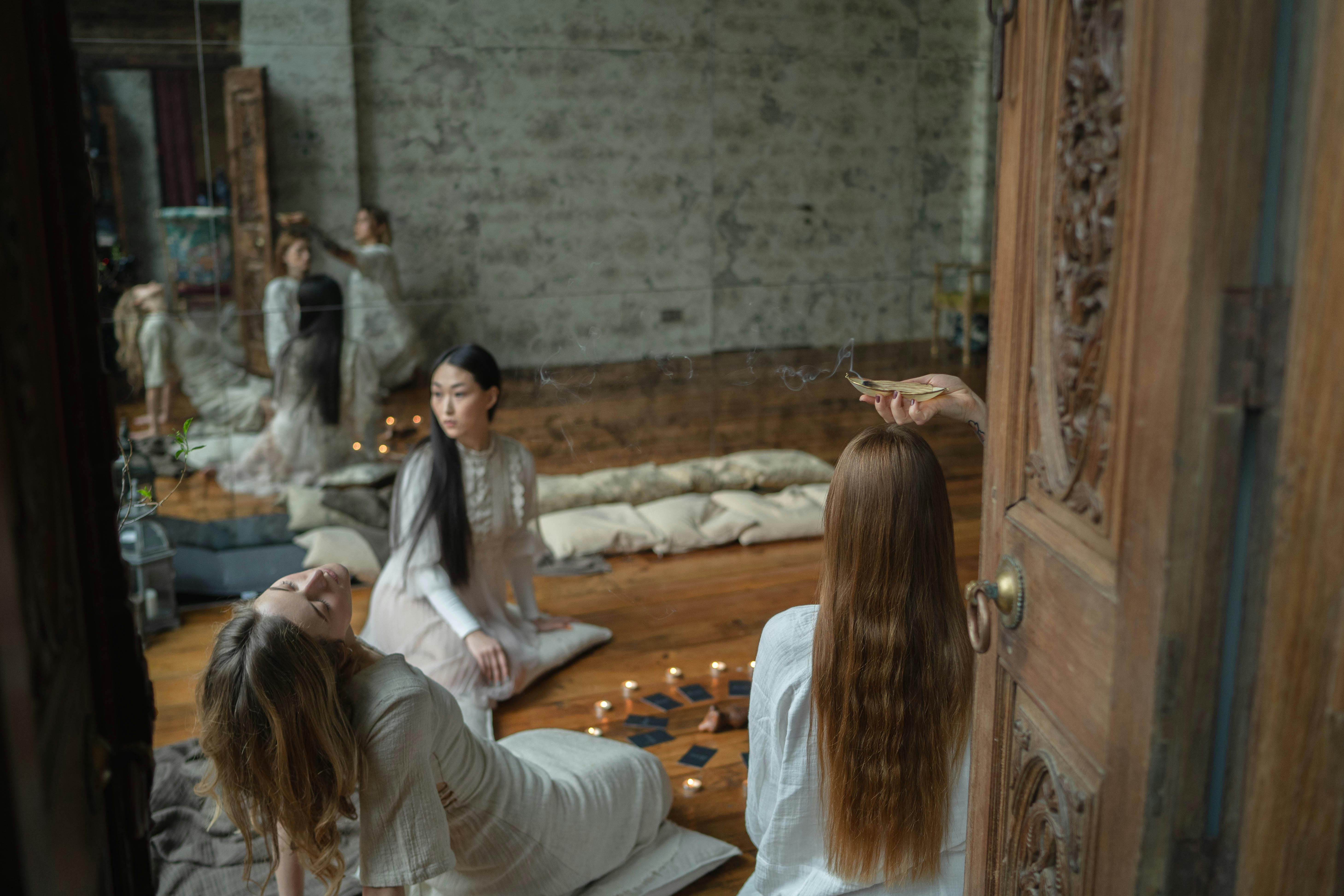
Photo by Anastasia Shuraeva: https://www.pexels.com/photo/women-meditating-together-6015514/
How Dianic Wicca Differs from Other Traditions
Most Wiccan systems, like Gardnerian and Alexandrian, are built on a structure of duality: God and Goddess, male and female, priest and priestess. Dianic Wicca breaks that entirely. It recognises the Goddess alone, rejecting the idea that divinity requires balance between genders.
Its rituals are smaller, looser, and more democratic. There’s no formal initiation or strict hierarchy. Authority is shared equally, and emotional truth takes priority over traditional structure. This makes Dianic practice highly adaptable - sometimes spontaneous, sometimes poetic, always personal.
Where other forms of Wicca often emphasise ceremonial structure or lineage, Dianic Wicca thrives on experience and expression. It’s not about getting it “right.” It’s about making it real.
Modern Influence and Legacy
Fifty years on, Dianic Wicca still casts a long shadow over modern spirituality. Its influence can be found everywhere: in Goddess worship, ecofeminism, women’s circles, and body-positive movements. It helped build a bridge between political feminism and spiritual practice, proving that magic could be both personal healing and cultural protest.
The internet has given the movement a second wind. Online covens meet under digital moons; rituals are shared across continents. Young witches have taken Budapest’s foundation and built new versions for the modern world - more inclusive, more intersectional, but still deeply rooted in empowerment and self-recognition.
Even outside of witchcraft, the echoes of Dianic Wicca remain. Its insistence that the female body is sacred, that emotions are powerful, and that nature mirrors the cycles of life, has influenced everything from therapy to art to environmental activism.
It endures because it offers something simple yet radical: the belief that the divine isn’t distant. It’s within us, breathing, moving, changing - and it belongs to everyone who chooses to claim it.