Skip to content

How Does Goth Culture Intersect With Other Alternative Movements?
Goth culture intersects with a wide range of alternative movements - including punk, metal, industrial, emo, steampunk, Wicca, Paganism, occultism, BDSM and kink communities, dark academia, and vampire subculture - sharing aesthetics, music, values, and physical spaces while remaining distinct from each of them. The overlaps are real, but they are not identity mergers. A goth who also identifies as a metalhead is still not the same as a metalhead who occasionally dresses in black.
Key Takeaways
- Goth grew directly out of post-punk in the late 1970s, so punk is the closest musical and cultural parent.
- Gothic metal, symphonic metal, and black metal share aesthetic and sometimes thematic ground with goth but come from a different musical tradition.
- Industrial and cyber goth sit at a direct overlap and share clubs, festivals, and audiences with the wider goth scene.
- Wicca, Paganism, occultism, and Satanism appear frequently in goth aesthetics, but as personal belief they are held by a minority of goths.
- Emo, steampunk, dark academia, and the vampire subculture are frequently confused with goth but each has its own history.
- The overlap between goth and BDSM/kink communities is long-standing, particularly around fetish clubs and shared venues.
Which alternative movements are closest to goth?
The alternative movements closest to goth are punk, industrial, metal (particularly gothic metal), and darkwave. These are the movements that share direct musical DNA, audience, and often physical venues with goth. They are not the same subculture, but they sit within one overlapping network of scenes.
The next tier out - emo, steampunk, dark academia, vampire subculture, and BDSM/kink - shares aesthetic ground and sometimes cultural overlap without sharing the musical roots.
The furthest tier - Wicca, Paganism, occultism, and Satanism - is not a music subculture at all, but overlaps significantly with goth at the level of imagery, values, and lifestyle.
The full map of sub-genres within goth culture covers the internal variations. This article is about the external ones.

Photo by Emma Benitez from Pexels: https://www.pexels.com/photo/a-man-with-green-mohawk-11879289/
How does goth intersect with punk?
Goth grew out of punk directly. The intersection is not a coincidence of aesthetics - it is a family relationship.
Punk emerged in the UK and US around 1975-76. By 1978-79, some bands were exploring darker, moodier, more atmospheric territory. Joy Division, Siouxsie and the Banshees, Bauhaus, and The Cure all had recognisable punk roots and developed the sound and imagery that later became known as gothic rock. The term "post-punk" describes this transition period, and post-punk is the direct parent of goth.
What goth kept from punk:
- DIY ethic
- Anti-mainstream posture
- Zine culture and independent labels
- Suspicion of authority
- Emphasis on personal expression over commercial polish
- Small, self-organised scenes and venues
What goth added:
- Slower tempos and atmospheric production
- Literary and Romantic references
- Elaborate visual codes drawn from Victorian and Gothic imagery
- Emotional and introspective lyrical themes
- Longer musical arrangements
The punk-goth relationship is still visible in shared venues, cross-billed gigs, and personal wardrobes. Many older goths are also punks, and many punks who kept going through the 1980s ended up at Batcave and Sisters of Mercy shows. If you want the fuller picture of how the goth scene evolved from post-punk, the timeline article covers it in detail.
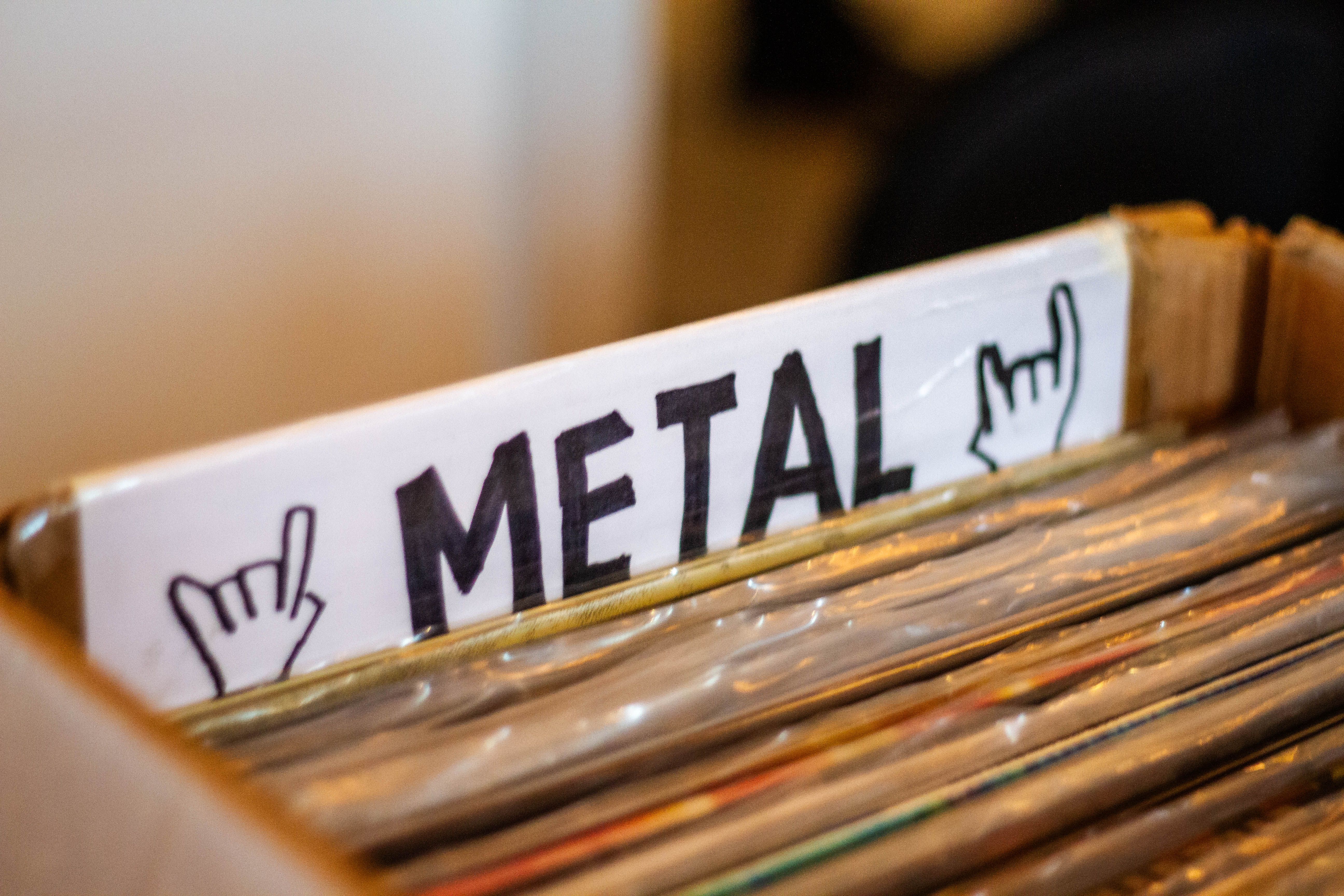
Photo by Cord Allman from Pexels: https://www.pexels.com/photo/close-up-of-metal-vinyl-records-box-in-store-38753694/
How does goth intersect with metal?
Goth intersects with metal at several specific sub-genres, particularly gothic metal, symphonic metal, doom metal, and parts of black metal. The audience overlap is significant, but the two scenes have different musical roots and different histories.
Gothic metal. Emerged in the early 1990s. Bands such as Paradise Lost, My Dying Bride, Anathema, Type O Negative, and later Lacuna Coil and Within Temptation combined the aesthetics of goth with the heavier sound of metal. Gothic metal is one of the clearest cases of a music genre that is both a sub-genre of metal and directly connected to the goth subculture.
Symphonic metal. Bands such as Nightwish, Epica, and Delain. Not always filed under goth but heavily used by goths who want orchestral and dramatic music.
Doom metal. Slow, heavy, atmospheric. Bands such as Candlemass, Electric Wizard, and Chelsea Wolfe (whose work spans folk, doom, and darkwave) sit at the intersection with goth.
Black metal. Emerged in the late 1980s and 1990s, particularly in Norway. Corpse paint, forest imagery, and occult themes give black metal a visual and thematic overlap with goth. The scenes are distinct - black metal has its own subculture with its own history, and some parts of it are politically and socially very different from goth - but individual fans often cross between the two.
The distinction to keep in mind: metal is a very large scene with its own subcultures. Goth overlaps with some of them significantly and with others hardly at all. A trad goth and a thrash metal fan are unlikely to share much beyond the general disposition toward black clothes.
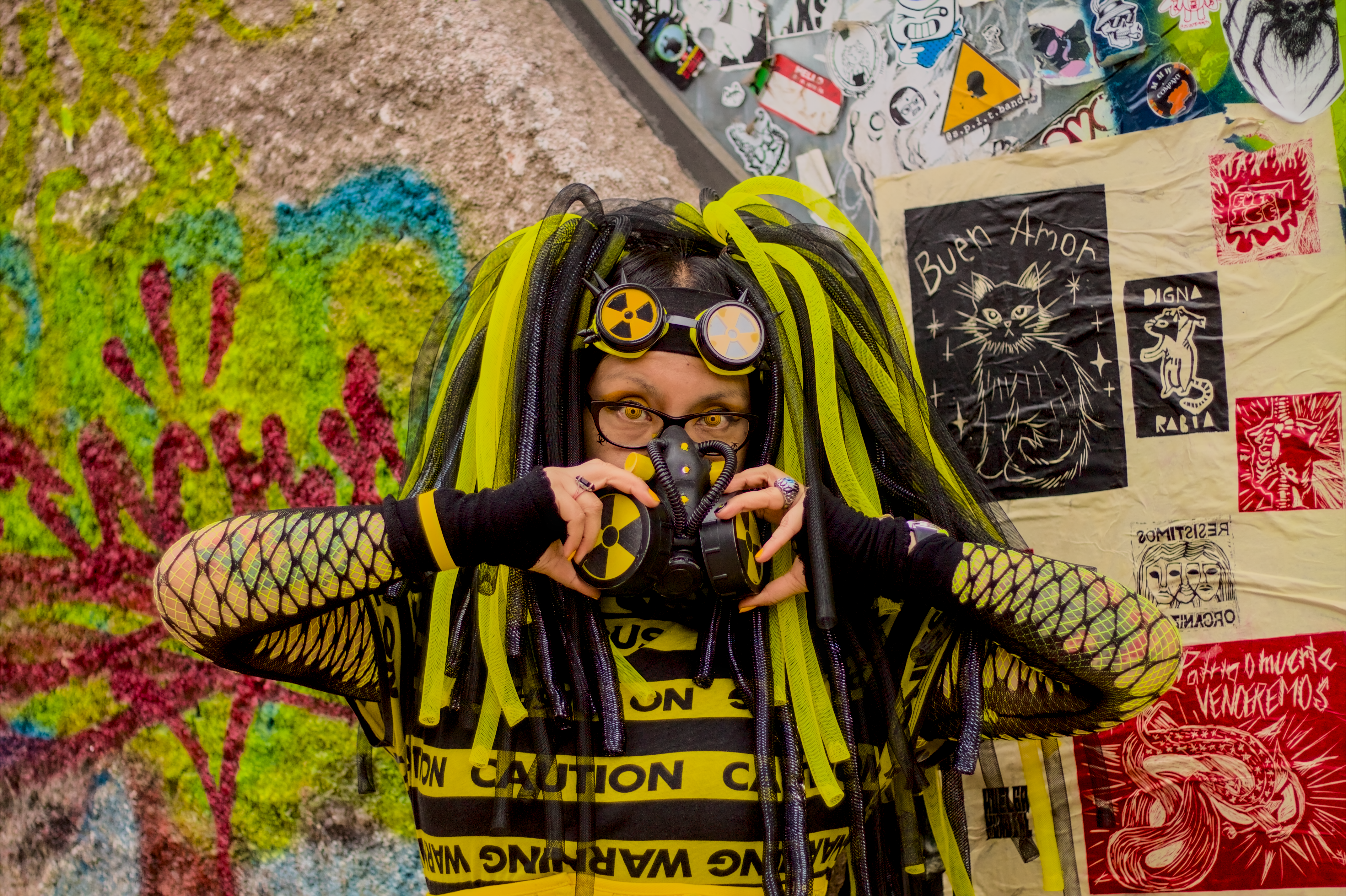
Photo by Guelang Morgan Seyer from Pexels: https://www.pexels.com/photo/colorful-urban-street-art-and-cyberpunk-costume-36738967/
How does goth intersect with industrial and cyber?
Industrial music and cyber goth sit at one of the closest and most active overlaps with goth. The intersection is so deep that many clubs, festivals, and DJ nights run both scenes as a single event.
Industrial music emerged in the late 1970s alongside post-punk. Early acts such as Throbbing Gristle, Cabaret Voltaire, and Skinny Puppy explored abrasive electronic sound with dark themes. By the 1990s, industrial had expanded into Electronic Body Music (EBM), dark electro, aggrotech, and futurepop, with acts such as Nitzer Ebb, Front 242, VNV Nation, Combichrist, and Covenant becoming central to the wider goth-industrial scene.
Cyber goth is the visual expression of this overlap. It combines the goth aesthetic with rave, cyberpunk, and futurist imagery - neon synthetic dreadlocks, gas masks, UV-reactive accessories, platform boots, and heavy black-and-neon colour palettes. Cyber goths typically attend industrial club nights rather than pure gothic rock nights, because the music suits their aesthetic.
Wave-Gotik-Treffen in Leipzig, M'era Luna in Hildesheim, and the London goth-industrial scene all treat these as one broadly connected community. Someone can go to a festival as a cyber goth, spend most of Friday at the industrial stage, and still be recognisably part of the wider goth world.
How does goth intersect with emo?
Goth and emo are frequently confused but are distinct subcultures with different musical and cultural roots. The intersection at the fan level is real - many people have been fans of both, particularly in the mid-2000s - but the subcultures themselves are not the same.
Emo (short for "emotional hardcore") emerged from the American hardcore punk scene in the mid-1980s, with bands such as Rites of Spring and later Sunny Day Real Estate. By the 2000s it had reached mainstream visibility through bands such as My Chemical Romance, Fall Out Boy, Panic! at the Disco, and Paramore.
The main areas of confusion:
- Both scenes favour dark clothing, particularly black.
- Both scenes are counter-cultural.
- Both scenes have been targeted by moral panics and hate crime.
- Both scenes overlap on mid-2000s alternative fashion (skinny jeans, side-swept fringes, band T-shirts).
The main differences:
- Goth is rooted in UK post-punk from 1979-83. Emo is rooted in US hardcore from the mid-1980s.
- Goth's musical canon is atmospheric, slow, and often orchestral. Emo's musical canon is guitar-driven, energetic, and confessional.
- Goth's aesthetic references are Victorian, Gothic literary, and horror. Emo's aesthetic references are alternative rock, teen culture, and personal confession.
- Goth is generally older as a scene by around a decade.
The confusion between the two is one of the most persistent public misunderstandings of the goth scene. Calling a goth "emo" is technically incorrect and, as the misconceptions about goth article notes, may be received accordingly.
How does goth intersect with steampunk?
Goth and steampunk overlap primarily through the sub-genre of steampunk goth, which combines Victorian aesthetics with steampunk's imagined alternate history of steam-powered technology. The two scenes share fashion vocabulary (corsets, waistcoats, top hats, pocket watches, brass accents) and have significant audience crossover, but they are separate movements.
Steampunk emerged as a literary and design movement in the 1980s, drawing on writers such as H.G. Wells and Jules Verne. As a subculture it developed through the 2000s, with its own conventions, publications, and craft communities. It is genuinely large enough to exist as an independent scene without any goth influence at all.
Where the two meet:
- Victorian visual references. Both scenes lean heavily on 19th-century fashion.
- Craft and DIY. Both scenes value handmade or modified clothing and accessories.
- Conventions and events. Steampunk conventions frequently attract goths, and goth festivals often have a visible steampunk contingent.
- Alternative fashion supply chain. Many of the same shops, makers, and designers supply both scenes.
Where they diverge:
- Steampunk is fundamentally science-fiction oriented. Goth is not.
- Steampunk is not built around a musical scene in the way goth is.
- Steampunk's core mood is one of adventure, invention, and optimism. Goth's core mood is not.
How does goth intersect with Wicca, Paganism, and occultism?
Goth intersects with Wicca, Paganism, occultism, and related spiritual movements at the level of aesthetics and lifestyle, and at the level of personal belief for a significant minority of goths.
The occult has been part of goth's visual and cultural vocabulary from the beginning. Pentagrams, sigils, tarot decks, moon imagery, and references to ceremonial magic show up regularly in goth fashion, album art, and interior décor. This is largely aesthetic. Most goths who wear occult symbols do not practice occultism in a serious spiritual sense.
That said, a real minority of goths are practising Pagans, Wiccans, occultists, or Satanists. The scene is more welcoming to these paths than most mainstream settings, and the aesthetic overlap makes movement between them frictionless.
Common intersections:
- Wicca. Nature-based, ritual-led, with clear symbolism (pentagram, moon, chalice) that reads perfectly within goth visual culture. Many nu goths and romantic goths have some engagement with Wiccan practice.
- Paganism more broadly. Includes traditions such as Druidry, Heathenry, and Hellenic Paganism. Overlaps with the medieval goth and dark folk sub-genres.
- Ceremonial magic and Thelema. Draws on figures such as Aleister Crowley. More common among older or more academically inclined goths.
- LaVeyan Satanism. Founded by Anton LaVey in 1966. Aesthetically overlaps with goth and has a well-established presence in the scene. Not to be confused with the theistic Satanism of moral-panic rhetoric.
- Chaos magic. Modern, syncretic, results-focused. Overlaps with sigil work and DIY spiritual practice that suits the scene's independent posture.
Whether these are held as serious belief or as aesthetic reference varies widely across the scene. The connection between the occult, witchcraft, and Wicca is worth reading if you want the distinctions between them.
How does goth intersect with BDSM and kink communities?
Goth and the BDSM/kink communities have a long-established overlap, particularly at the level of shared venues, dress codes, and aesthetic vocabulary. The intersection is not universal, but it is significant, and it has been visible since the 1980s.
Where the overlap shows up:
- Fetish clubs. Many major fetish clubs, particularly in London and Berlin, share crowds, DJs, and dress codes with goth clubs.
- Fashion vocabulary. Latex, leather, corsets, chokers, collars, boots, and harnesses are worn in both scenes, often at the same events.
- Photography and art. Fetish and goth aesthetics have converged in commercial photography, editorial work, and album art since the 1990s.
- Personal identity. A significant minority of goths are also practising kinksters, and the scene has generally been welcoming to that identity.
Where the two are not the same:
- Goth is a music and lifestyle subculture. BDSM is a sexual practice and community.
- Not all goths are kinky, and not all kinksters are goth.
- BDSM has its own etiquette, safety practices, and internal codes that are separate from goth culture.
The intersection is one of the more sensitive ones to describe accurately, because it has been sensationalised in media coverage and dismissed by defensive commentators. The reality is that the two scenes are separate but comfortably close, and the crossover is a normal part of the wider alternative landscape.
How does goth intersect with the vampire subculture?
Goth and the vampire subculture overlap heavily at the level of literature, film, and aesthetics, and there is a small but real community of self-identified vampires with connections to the wider goth scene.
The literary and cinematic intersection is straightforward. Anne Rice's Interview with the Vampire (1976) is a foundational text for the romantic goth aesthetic. Bram Stoker's Dracula, Sheridan Le Fanu's Carmilla, and later works such as The Vampire Chronicles and the film The Hunger (1983) all sit within both traditions.
Beyond the literary and cinematic overlap, there is a distinct vampire subculture that developed in the 1990s and 2000s, primarily in the US, with its own conventions, terminology, and practices. It includes people who identify with vampire imagery and mythology, sometimes as a lifestyle aesthetic and sometimes as a claim about their own energy or blood needs.
The vampire subculture is not the same as goth, and most goths are not vampires. The subcultures share venues, media references, and some fashion, but they are separate identities. The overlap is closest at the romantic goth end of the scene and the Victorian goth end, both of which draw directly on the vampire literary tradition.
How does goth intersect with dark academia?
Dark academia is a mostly online aesthetic movement that emerged in the mid-to-late 2010s, focused on classical education, university culture, ancient languages, and 20th-century tweed. It overlaps with goth at the level of Gothic literature, moody photography, and a shared preference for atmosphere over cheerfulness.
Where the two meet:
- Both draw on Gothic and Romantic literary traditions.
- Both use candles, old books, and antique interiors as part of their visual language.
- Both prefer autumn and winter to summer, and both prefer overcast weather to bright sunshine.
- Both take reading seriously as a lifestyle activity.
Where they differ:
- Dark academia's visual palette is browns, tweeds, oxblood, and cream. Goth's is primarily black.
- Dark academia is oriented around universities and classical education. Goth is not.
- Dark academia is not a music scene. Goth is.
- Dark academia largely emerged online. Goth emerged in physical venues and remains venue-oriented.
The two overlap in one significant modern hybrid: the dark academia goth, who reads Poe in a candlelit library while wearing an oxblood cardigan over a lace collar. Both wardrobes work. Neither community feels the need to argue about it.
How does goth intersect with cyberpunk?
Goth and cyberpunk overlap primarily through cyber goth, which combines the cyberpunk aesthetic - dystopian futures, biomodification, neon and grime - with the goth wardrobe. The two movements share dystopian mood and visual DNA, but cyberpunk is a science-fiction genre rather than a music-led subculture.
Cyberpunk emerged as a literary movement in the 1980s, with writers such as William Gibson (Neuromancer) and Bruce Sterling. It became a visual and design movement through films such as Blade Runner and The Matrix, and later a subculture in its own right.
The overlap with goth appears in fashion (platform boots, black clothing, neon accents), in music (industrial and EBM share the cyberpunk mood), and in worldview (both scenes are broadly sceptical of mainstream techno-optimism). Cyber goth is the sub-genre where these overlaps are most active.
Where do these movements physically meet?
The physical spaces where these alternative movements meet are worth naming, because they explain how the intersections stay alive across generations.
Clubs. Slimelight (London), Slaughtered Lamb (London), Das Bunker (Berlin), Batcave successors around the UK, and dedicated goth-industrial nights in most major cities. These venues typically host mixed crowds - goth, industrial, cyber, occasionally metal.
Festivals. Whitby Goth Weekend (UK), Wave-Gotik-Treffen (Leipzig), M'era Luna (Hildesheim), Amphi Festival (Cologne), and Convergence (US). These are the largest formal gatherings where the intersecting scenes converge. The article on rituals, gatherings, and community spaces covers these more fully.
Comic and book fairs. Alternative book fairs, comic conventions, and horror film festivals attract heavy crossover audiences from goth, steampunk, dark academia, and vampire subcultures.
Occult shops and Pagan gatherings. Physical shops that stock tarot, herbs, occult books, and ritual tools frequently attract goths, Wiccans, and Pagans as overlapping customer bases.
Online spaces. Discord servers, subreddits, and Tumblr communities have become the modern default meeting point, particularly for younger goths and for the more aesthetics-led sub-genres.
Comparison of goth's main alternative overlaps
The short summary below gives a working sense of where each intersection sits on shared music, shared aesthetics, and shared spaces.
|
Movement |
Shared music |
Shared aesthetics |
Shared spaces |
|---|---|---|---|
|
Punk |
High (post-punk) |
Medium |
High |
|
Metal (gothic/doom) |
Medium-high |
High |
Medium |
|
Industrial |
Very high |
High |
Very high |
|
Emo |
Low |
Medium |
Low-medium |
|
Steampunk |
Low |
High (Victorian) |
Medium |
|
Wicca/Paganism |
Low |
High (occult) |
Medium |
|
BDSM/kink |
Low |
High |
Medium-high |
|
Vampire subculture |
Low |
Very high |
Medium |
|
Dark academia |
Very low |
High |
Low (mostly online) |
|
Cyberpunk |
Medium (industrial) |
Medium-high |
Medium (cyber goth) |
FAQ
Is goth the same as metal? No. Goth grew from post-punk in the late 1970s, and metal grew from hard rock in the same period but along a different line. They share some visual codes and some sub-genres (gothic metal, symphonic metal) but the two scenes have separate histories, canons, and communities. Many people are fans of both, but that does not make them the same subculture.
Are all goths into the occult? No. Occult imagery is common in goth aesthetics, but most goths do not practice occultism as a serious spiritual path. A minority do, and the scene is welcoming to them, but wearing a pentagram in the goth scene does not automatically mean spiritual practice.
Do goths and emos share the same scene? Not really. There has been fan-level overlap, particularly in the mid-2000s, but goth and emo are separate subcultures with different musical histories, aesthetic references, and communities. The two are often confused by outsiders, which is one of the most persistent public misunderstandings of both scenes.
Is Wicca a type of goth? No. Wicca is a modern Pagan religion, not a subculture. Some goths are Wiccans, and Wicca fits the scene's aesthetic and values well, but the two are separate. A Wiccan does not have to be a goth, and a goth does not have to be a Wiccan.
How do goth and BDSM communities overlap? Through shared venues, shared fashion vocabulary, and shared audiences, particularly in the fetish club scene. The two are not the same - goth is a broad music and lifestyle subculture, BDSM is a sexual practice and community - but the overlap has been long-standing and is well-established.
Is cyber goth the same as cyberpunk? Not quite. Cyberpunk is a science-fiction genre and broader subculture. Cyber goth is a sub-genre of goth that borrows heavily from cyberpunk aesthetics. All cyber goths are influenced by cyberpunk. Not all cyberpunk fans are goths.
Which alternative movement is closest to goth? Industrial. The overlap in music, venues, festivals, and audiences is the closest of any alternative scene. Cyber goth exists specifically at this crossover. Punk is the closest ancestor. Wicca and Paganism are the closest overlap in belief and lifestyle for goths who lean spiritual.
Whether you sit at the punk end, the cyber end, or the Wiccan-adjacent end of goth's wider network of scenes, our gothic patches, gothic pins, and occult necklaces are an easy way to signal where your identity actually lives.