Skip to content

What is The Threefold Law in Wicca?
The Threefold Law in Wicca is the belief that whatever energy a person sends out into the world - good or bad - returns to them three times over.
That is the short answer. The longer answer is more interesting, and a bit messier, because the Threefold Law is not as old, not as universal, and not as fixed as many people assume.
It is one of the most quoted ideas in modern Wicca. It is also one of the most argued over. Some Wiccans treat it as a serious moral and magical rule. Others think it is a well-meaning misunderstanding that got out of hand. Both groups can point to good reasons. So before you decide which camp you fall into, it helps to know what the law actually claims, where it came from, and why it still causes debate today.
Key Points
- The Threefold Law states that the energy you send out - whether kind or cruel - comes back to you three times as strong.
- It has a modern origin. It first appeared in a 1949 novel by Gerald Gardner, the man most linked with the public birth of Wicca.
- In its original form it was about returning good to other witches, not a cosmic punishment system for everyone.
- The American witch Raymond Buckland did the most to turn it into a formal "law" in his published work.
- It is often compared to karma, but that comparison breaks down quickly.
- It is not universal. Many Wiccans and witches reject it entirely.
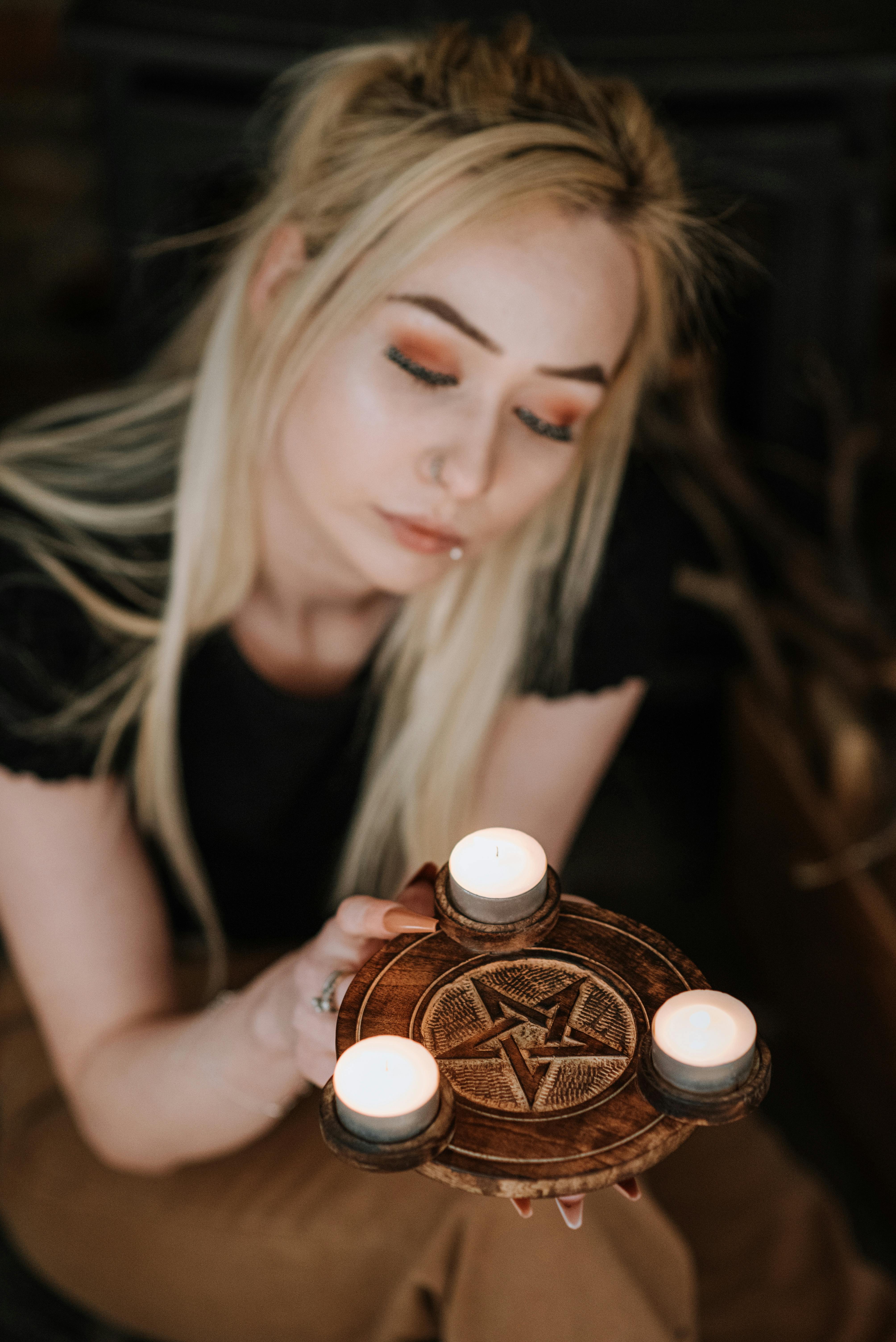
Photo by Anete Lusina from Pexels: https://www.pexels.com/photo/enchantress-with-pentagram-and-shiny-candles-7256695/
What the Threefold Law Actually Says
At its core, the Threefold Law is a claim about consequence.
It says that your actions, your intentions, and the magical energy you raise do not simply vanish once they leave you. They circle back. And when they return, they return amplified, hitting you three times harder than the force you first sent out.
Send out kindness, healing, and goodwill, and you can expect threefold blessing in return. Send out spite, harm, or a curse, and you should brace for three times the damage landing back on your own doorstep.
That is why the law works on two levels at once. It is an ethical guide, telling you how to behave. It is also a magical principle, telling you what happens when you cast a spell. For many Wiccans, the two cannot be separated. The way you treat people and the way you do magic are the same question, judged by the same standard.
It is a tidy idea. Almost too tidy, which is part of why it gets challenged.
Where the Threefold Law Came From
Here is the part that surprises people. The Threefold Law is modern.
Its earliest known appearance is in Gerald Gardner's 1949 novel High Magic's Aid. Gerald Gardner is the figure most strongly tied to the public arrival of Wicca, and at the time he wrote the book, witchcraft was still illegal in Britain, so he framed his ideas as fiction. In the story, a character going through an initiation is told that when he receives good, he is bound to return good threefold.
Read that carefully, because it matters. The original line was not about the universe automatically punishing wrongdoers. It meant that when someone does good to a witch, the witch should return that good three times over. It was about reciprocity between people. Specifically, it was about returning kindness, not about cosmic payback for cruelty.
So how did a single line in a novel become a sweeping law of magical consequence?
The answer is largely down to one man. The Threefold Law as an actual "law" was first publicised by the witch Raymond Buckland in his books on Wicca. Buckland was an initiate of Gardner's tradition who later moved to the United States and carried Gardnerian teachings with him. Through his writing, the idea spread, hardened, and became one of the standard pillars of popular Wicca.
The idea also turns up in the long poem version of the Wiccan Rede, which tells readers to keep the threefold law in mind, since what you do comes back three times bad and three times good. That poem helped lock the law into the public image of Wicca.
But - and this is the key point - before Buckland, Wiccan ideas about reciprocal ethics were far less defined and were more often understood as a general kind of karma. The strict "three times" rule was an interpretation, not an original commandment.
In my view, this history should be stated plainly and without embarrassment. The Threefold Law is a modern idea built on a line of fiction. That does not make it worthless. It makes it honest to call it what it is.
The Threefold Law and the Wiccan Rede
You cannot really understand the Threefold Law without its partner, the Wiccan Rede.
The Rede is the best-known ethical statement in Wicca, usually boiled down to the idea of doing what you will, as long as it harms none. It is advice. It tells a Wiccan how to act.
The Threefold Law is the other half of the deal. If the Rede is the guidance, the Threefold Law is the consequence. Harm none, the Rede says. And if you do cause harm, the Threefold Law warns, it will come back on you three times worse.
That is why the two are so often taught together, as a matched pair of carrot and stick. The Rede appeals to your better nature. The Threefold Law appeals to your self-interest. Between them, they are meant to keep a witch honest.
There is a problem with that, though, and it is worth saying out loud. A rule you follow only because you fear punishment is not really ethics. It is just caution. Genuine morality means choosing to harm none because you care about not harming people, not because you are scared of a magical boomerang or something. Plenty of thoughtful Wiccans make exactly this point.

Photo by Anete Lusina from Pexels: https://www.pexels.com/photo/crop-fortune-teller-predicting-fate-near-burning-candle-4790558/
Is It Really "Threefold"? The Debate Over the Number
Why three? Why not double, or tenfold, or simply equal?
This is one of the oldest arguments around the law, and there is no agreed answer.
Some Wiccans explain the number through the idea that a person acts on three levels at once - body, mind, and spirit - so the return touches all three. Others link it to the Triple Goddess in her three forms of Maiden, Mother, and Crone, a figure central to a great deal of modern Pagan practice. Others simply say three is a sacred number found across many traditions and leave it there.
And then there are the practitioners who think the number was never meant to be taken literally at all.
This is where I land. Treating "three times" as exact mathematics misses the point. Nobody is standing by with a ledger, multiplying your good deeds by precisely three. The figure is symbolic. It is a way of saying that consequences are larger than we expect, that small actions have effects out of proportion to their size, and that what we do tends to come back on us in ways we cannot fully predict. Read like that, the law makes sense. Read like accounting, it falls apart.

Photo by Sed "Creatives" Sardar from Pexels: https://www.pexels.com/photo/photo-of-a-woman-lying-on-the-ground-14537131/
The Threefold Law vs Karma
People reach for karma the moment the Threefold Law comes up. It is the obvious comparison. It is also a flawed one.
Karma comes from Hindu and Buddhist thought, where it is a deep and detailed teaching about cause and effect stretched across many lifetimes. In those traditions, the results of your actions may not arrive for years, or even until a future life. It is slow, vast, and tied to ideas about rebirth and the soul.
The Threefold Law is faster and smaller. It promises a return within this life, often soon, and it bolts on a fixed multiplier that real karmic teaching never had. Lifting the word "karma" and pinning a "times three" sticker on it does a disservice to both ideas.
So yes, the two rhyme. Both say actions have consequences. But the Threefold Law is not karma, and treating it as a Western nickname for karma flattens a rich tradition into a slogan. If you want to understand either properly, keep them apart.
Literal or Symbolic? How Wiccans Interpret It
Ask ten Wiccans what the Threefold Law really means, and you will get a spread of answers.
At one end sit those who take it literally. For them it is a genuine law of the universe, as real as gravity, an actual mechanism that measures out consequence with a heavy hand. Cast harm and harm rebounds, full stop.
At the other end sit those who read it as a metaphor. To them the law is a moral lesson dressed in magical language, a memorable way of teaching personal responsibility. It is not a force. It is a reminder.
In between are practitioners who treat it as psychological truth. Their argument is that a person who spends their time wishing harm on others becomes bitter, suspicious, and unhappy, and that this is the "threefold return" in plain clothes. The cruelty you nurse poisons you long before it touches anyone else.
All three readings survive happily inside Wicca, because Wicca has no single authority to settle the matter. That openness is one of its strengths, even if it frustrates anyone hoping for a neat definition.
How the Threefold Law Shapes Magic
The law has real, practical effects on how many Wiccans do magic.
Its biggest impact is on harmful magic - curses, hexes, and binding spells. A Wiccan who believes in the Threefold Law will think very hard before cursing anyone, because the belief tells them the curse will rebound three times as hard. That single idea has kept a lot of angry people from doing magical damage they would later regret. As a brake on impulse, it works rather well.
But this is also where the law draws its sharpest critics, and they have a point. Plenty of witches argue that a tradition forbidding all harmful magic leaves its followers unable to defend themselves. If someone is attacking you, they say, refusing to fight back is not virtue, it is helplessness. These witches practise protective and even baneful magic without apology, and they reject the Threefold Law as a leash that benefits bullies.
My own position is somewhere in the middle. Magic without ethics is reckless. But ethics that forbid all self-defence are not ethics either, they are surrender. A thoughtful witch can hold both ideas at once: be slow to harm, but not defenceless.
Criticisms and Disagreements
The Threefold Law takes a fair amount of fire, and not from outsiders alone. Some of the loudest critics are Wiccans and witches themselves.
The first criticism is historical. The law is modern, not ancient, and dressing it up as timeless wisdom is simply bad history. The second is that it is not universal. Neither the Rede nor the Threefold Law was originally part of traditional Wicca, and many practitioners have always done without them. Most Gardnerians outside a few specific lines believed in a more general law of return rather than a special rule built around the number three.
The third criticism is the one about the number, which we have already covered: three looks arbitrary.
The fourth is philosophical, and to me it is the strongest. A law that says "be good or you will be punished threefold" turns morality into a transaction. It teaches people to behave well out of fear for themselves rather than care for others. That is a thin kind of goodness. The best Wiccans I have read know this, and treat the law as a starting point for thinking about consequence rather than the final word on right and wrong.
Misunderstandings About the Threefold Law
A few myths cling to this subject, and they are worth clearing away.
The first myth is that all Wiccans believe it. They do not. It is common, but it is not a requirement, and plenty of serious Wiccans reject it.
The second myth is that it is ancient. It is not. Its roots are in a 1949 novel and its popular form is younger still.
The third myth is that it works like instant punishment, an immediate zap the moment you do something wrong. Even taken at face value, the law never promised that. Consequences in this view can be slow and indirect.
The fourth myth is that it makes Wiccans pushovers, unable to protect themselves. As we have seen, that depends entirely on the witch. Belief in the law varies, and so does how far people take it.
Why the Threefold Law Still Matters
Given all the criticism, you might ask why the law has lasted at all. The answer is that it does something useful.
It gives Wicca a built-in ethical check. It tells a new practitioner, in plain and memorable language, that magic is not a toy and that actions carry weight. For someone holding real power over candle, word, and will for the first time, that reminder has value.
It also encourages personal responsibility. The law puts the outcome of your choices back in your own hands. You did this, it says, so this is coming back to you. That is a grown-up message, even if the "three times" packaging is rough.
And at its best, stripped of the literal arithmetic, the law points at a truth most people already know. What you put into the world shapes what you get out of it. Cruelty tends to breed cruelty. Kindness tends to draw kindness back. You do not need to believe in a cosmic multiplier to see that this is broadly how life works.
It is a modern idea, born from a line in a 1949 novel and shaped into a formal law by later writers, above all Raymond Buckland. It is not ancient. It is not universal. The famous number three is almost certainly symbolic rather than literal. And it is not really the same thing as karma, however often the two get muddled.
But none of that makes it pointless. Treated as a moral framework rather than a proven law of the universe, the Threefold Law has real worth. It asks witches to think before they act, to weigh consequences, and to take responsibility for the energy they put into the world. That is a solid foundation, whether or not the cosmos is truly keeping score in threes.
Take the lesson seriously. Take the maths with a pinch of salt.
Whether your path leans Wiccan, Pagan, or full occult goth, our gothic pins, occult necklaces, and gothic patches are an easy way to carry that symbolism with you every day.