Skip to content

What Happens During a Wiccan Ritual?
Forget the stereotypes. A Wiccan ritual isn’t a shadowy ceremony or a relic from folklore. It’s a structured act of reverence - part prayer, part performance - carried out with discipline and purpose. Practitioners use ritual to align themselves with nature’s cycles, to honour deities, and to direct energy toward change. The outer details differ between traditions, but the pattern stays constant: the space is prepared, the circle cast, the elements and deities invoked, the work performed, and the circle finally closed.
Each step is practical and symbolic at once. It grounds the practitioner in both physical and spiritual focus, turning ordinary surroundings into a temporary temple.
Key Points
-
Structured Practice: Wiccan rituals follow a set pattern - preparation, circle casting, invocation, working, and closure.
- Sacred Space: The circle marks a boundary where the spiritual and physical meet.
- Invocation: Elements and deities are invited to bring balance and guidance.
- Energy Work: Focused intent raises and directs energy for healing, celebration, or change.
- Ethical Focus: Guided by the Rede and Threefold Law, rituals honour life and reject harm.
Preparing the Space
Before anything sacred can take place, the space must be cleared. This isn’t simply tidying up; it’s a psychological and energetic reset. Wiccans believe that physical disorder or leftover emotion can muddy the energy of a ritual. Clearing the area, therefore, becomes the first act of intent.
A besom - the traditional witch’s broom - may be used to sweep the ground, moving not only dust but stagnant energy. Some sprinkle salt water to cleanse, others burn incense or herbs such as sage, rosemary, or frankincense. The air becomes charged with scent and purpose. These gestures mark the threshold between the ordinary and the sacred, helping the mind settle into ritual awareness.
Many practitioners work indoors, setting up a temporary altar on a table or chest. Others prefer the open air, where the natural sounds of wind, water, or birds become part of the ceremony. What matters is not location but focus: once the space is declared sacred, it becomes a microcosm of the universe, a reflection of the balance Wicca teaches.
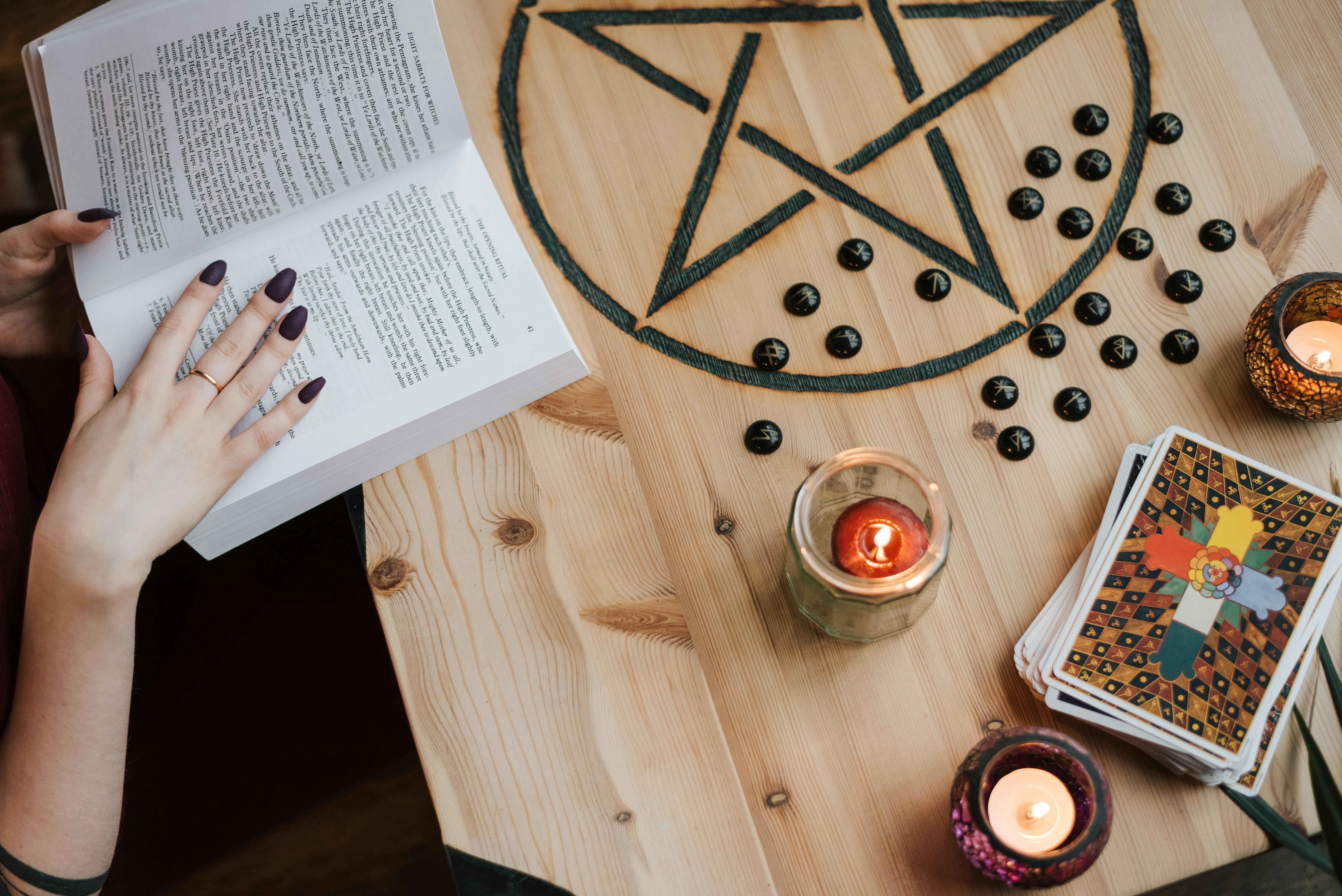
Photo by Anete Lusina: https://www.pexels.com/photo/faceless-soothsayer-reading-magic-book-while-predicting-fate-4790580/
Casting the Circle
The circle lies at the heart of Wiccan ritual. It represents unity, protection, and continuity - a contained space in which the laws of the material world pause for a while. To cast it, a practitioner moves around the perimeter, tracing an invisible boundary with a ritual tool such as an athame, wand, or even a bare hand. Some visualise a ring of blue or golden light forming around them; others chant or recite words passed down through their tradition.
Inside that circle, the atmosphere changes. The act of marking it out signals the beginning of sacred time, a moment that stands apart from the ordinary. Many describe it as a feeling of suspension, of standing “between the worlds,” where the physical and spiritual overlap. The circle also defines safety - not from outside threats, but from distraction. It’s a psychological perimeter as much as a magical one, giving structure to the ritual and focus to the mind.
The idea of the circle predates modern Wicca, appearing in ancient and medieval ceremonial practices. Gerald Gardner, the mid-twentieth-century founder of modern Wicca, formalised its role as both a spiritual boundary and a container of raised energy. That influence remains clear in contemporary rituals.
Calling the Elements and Deities
Once the circle is complete, the practitioner turns to the directions, acknowledging the natural forces that sustain life. Each quarter - East, South, West, and North - is linked to an element: Air, Fire, Water, and Earth. Small representations are placed at each point of the compass - incense for Air, a candle for Fire, a bowl of water for Water, and salt or stone for Earth.
The calling of the quarters is both poetic and practical. It balances the space, reminding participants that all four elements are present and must work in harmony. The words used are personal: some quote traditional invocations, while others speak freely, thanking each element for its qualities - intellect and breath for Air, passion and transformation for Fire, emotion and intuition for Water, stability and growth for Earth.
Next, the deities are invited. Wicca is generally duotheistic, honouring both a Goddess and a God, who together represent life’s creative balance. Names vary by tradition. Some invoke Brigid, Hecate, or Cernunnos; others use general titles such as the Lady and the Lord. For many practitioners, these deities are real entities; for others, they are personifications of natural or psychological forces. Invocation is about partnership, not subservience. The gods are welcomed as equals in shared purpose, rather than remote powers to be appeased.
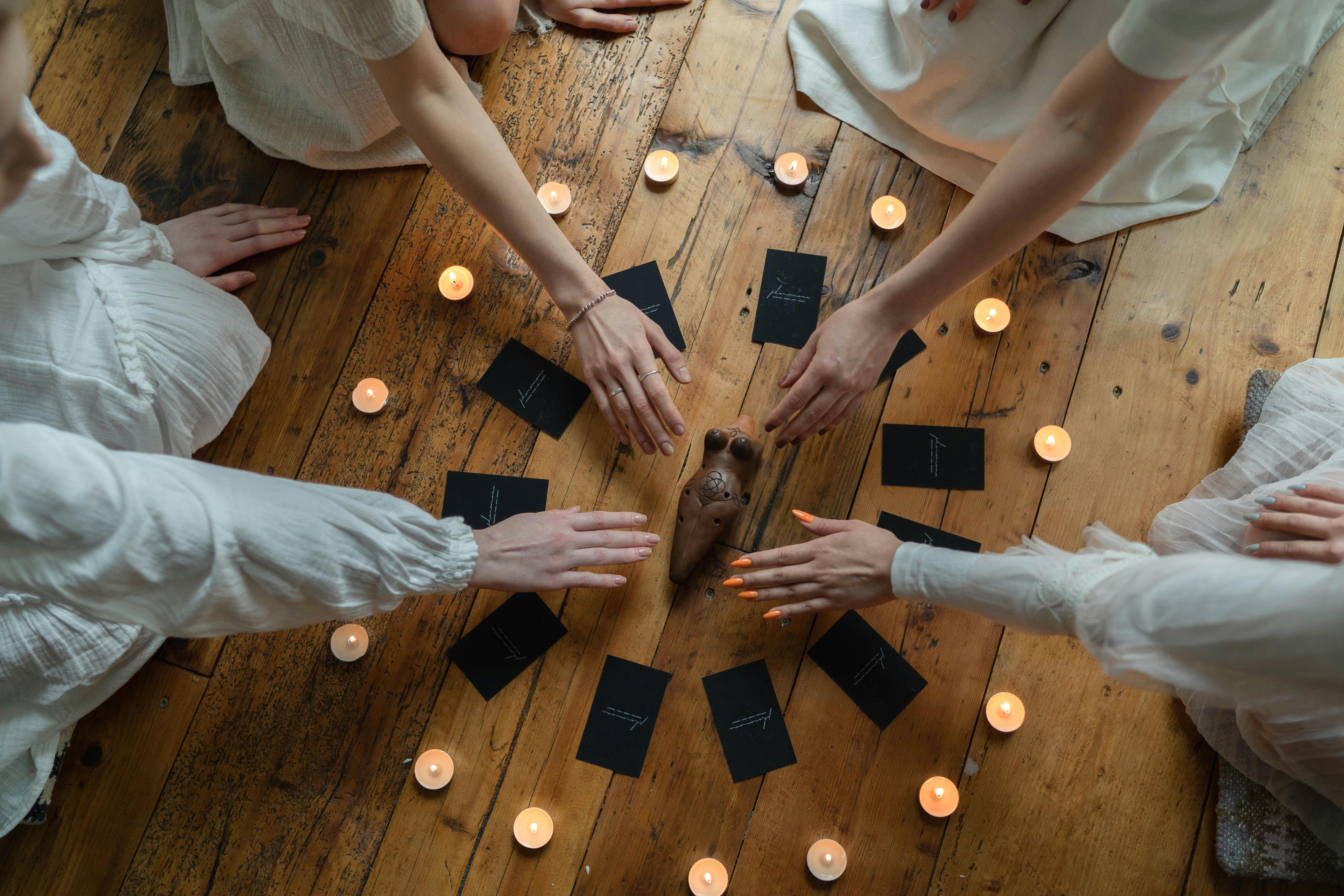
Photo by Anastasia Shuraeva: https://www.pexels.com/photo/people-holding-black-and-brown-cards-6015507/
The Core of the Ritual
Everything before this point is preparation. The centre of the ritual - sometimes called “the working” - is where intention meets action. Its nature depends on timing and purpose.
During a Sabbat, the ritual celebrates a festival from the Wheel of the Year - eight points marking the agricultural and solar cycle. Samhain focuses on death and memory, Yule on rebirth, Beltane on fertility and vitality. These festivals connect practitioners to the shifting seasons, keeping them mindful of nature’s cycles.
During an Esbat, usually held under a full moon, the focus turns inward. The light of the moon symbolises intuition, reflection, and the fluid nature of emotion. Esbats are often used for spellwork - acts of directed intent aimed at healing, protection, or personal growth.
Energy raising is the pivotal act. Participants may drum, dance, chant, or meditate to build a tangible sense of power. The rhythm accelerates until the energy peaks, then it’s released - sent into the universe to manifest the desired change or offered back to the Earth in gratitude. The process can feel electric, emotional, or quietly profound, depending on the group’s temperament.
Wiccan magick is not about commanding invisible forces but working in harmony with them. It’s based on the belief that energy follows thought, and that focused intent, properly grounded, can influence both inner and outer reality.
Grounding and Closing
When the work is done, the energy must be released and the circle opened. This closing phase is as deliberate as any other part of the ritual. Without it, the practitioner might feel mentally unsteady or “buzzing,” as though the mind hasn’t returned from the altered state of focus.
Grounding techniques vary. Some eat bread and drink wine - not in a sacramental sense, but as a way of reconnecting with the body. Others place their hands on the ground or visualise roots extending into the soil, dispersing excess energy. The goal is stability. The deities and elemental guardians are thanked, their presence acknowledged before being released. The circle is then opened, often in the reverse direction to which it was cast.
What remains is calm, sometimes euphoric, sometimes reflective. The ritual ends not with spectacle but with quiet awareness - the sacred fading gently back into the ordinary.
Ritual Tools and Their Meanings
Every Wiccan ritual relies on symbolism. The tools themselves hold no intrinsic power; their value lies in how they focus intention. A few are especially common:
-
Athame: a ritual blade, usually black-handled, representing will, courage, and direction. It is never used to cut physically but to guide energy.
-
Chalice: a cup associated with the element of Water and the feminine principle, used in libations or symbolic unions.
-
Pentacle: a flat disc inscribed with a five-pointed star, representing Earth, manifestation, and protection.
-
Wand: linked to Air or Fire, depending on tradition; used for communication, invocation, or gentle redirection of energy.
-
Cauldron: an ancient emblem of transformation, fertility, and renewal.
Some practitioners add personal items: crystals, feathers, seashells, or photographs of ancestors. Each addition individualises the altar, turning it into a reflection of the practitioner’s spiritual landscape.
Group and Solitary Practice
Wiccan ritual can be a solitary act or a shared experience. In coven settings, structure is paramount. A High Priestess or High Priest leads, supported by others who take roles in casting the circle or invoking the elements. The choreography may seem theatrical, but the intention is serious. The shared rhythm of voices and movements builds collective energy, creating a sense of unity rare in ordinary life.
Solitary practitioners adapt the same framework but internalise it. Alone, they speak the invocations quietly or silently, meditating through each stage. Their rituals are often more flexible, less formal, and highly personal. Solitary work allows for introspection and privacy, but it also demands focus; without the energy of a group, the practitioner must sustain the ritual’s intensity alone.
Both forms are legitimate. What defines a Wiccan ritual is sincerity and structure, not attendance.
Ethics and Misconceptions
Ethics sit at the centre of Wiccan belief. The best-known principle, the Wiccan Rede, states: “An it harm none, do what ye will.” It isn’t a licence for indulgence, but a call to accountability. Every action, magical or mundane, carries consequences.
Many Wiccans also observe the Threefold Law - the idea that whatever energy you send returns threefold. Whether taken literally or symbolically, it reinforces caution and empathy. Magick is not about control or dominance; it’s about harmony.
Public misunderstanding persists, often shaped by sensationalism or confusion with darker practices. Wicca rejects cruelty, coercion, and harm. Its rituals revolve around respect - for nature, for other beings, and for the balance that sustains existence.
A Wiccan ritual is both simple and profound. Beneath the incense smoke and candlelight lies a disciplined spiritual framework, designed to connect the human mind with natural rhythm and divine principle. It’s neither performance nor fantasy, but a deliberate act of focus - a way to translate belief into tangible experience.
Each ritual is personal. Some are solemn and quiet, others exuberant and musical, yet all share a single goal: to bring the practitioner into harmony with the forces they honour. When done well, a ritual leaves a lasting clarity - a sense that, for a brief time, the sacred and the everyday touched and recognised each other.
That is what truly happens during a Wiccan ritual.
After some cool Wicca jewellery? Have a look at our Wicca Pentagram Earrings and Wicca Pentagram Necklace!