Skip to content


What Is the Role of Gender, Sexuality and Identity in Satanist Paths?
Gender, sexuality and identity occupy a central place in modern Satanism, which has historically defended sexual freedom, bodily autonomy, and gender nonconformity more explicitly than most religious traditions. The Satanic figure has been used as a symbol of liberation by feminists since the nineteenth century, and Baphomet, Satanism's most recognisable icon, was deliberately drawn as neither male nor female.
Key Takeaways
- The Satanic Bible (1969) endorsed sexual freedom, including homosexuality and non-monogamy, at a time when homosexual acts were still criminalised in much of the United States and had been decriminalised in England and Wales only two years earlier.
- Eliphas Lévi's 1856 Baphomet illustration combined male and female attributes deliberately, as a symbol of the union of opposites. Its androgyny is original, not a modern reinterpretation.
- Per Faxneld's Satanic Feminism (Oxford University Press, 2017) documents how nineteenth-century feminists used Lucifer and the Eden narrative as liberation imagery.
- The Satanic Temple's Third Tenet, on the inviolability of one's own body, underpins its campaigns on reproductive rights and against conversion therapy.
- Anton LaVey's The Satanic Witch (1971) contains rigid and dated gender essentialism that sits awkwardly with the movement's broader libertarianism, and is criticised on those grounds within Satanism.
- Satanist organisations attract disproportionately high LGBTQ+ participation, largely because they offered explicit acceptance earlier than most alternatives.
Why is gender central to Satanist symbolism?
Gender is central to Satanist symbolism because the tradition's defining icons are deliberately ambiguous or transgressive on gender, and because Satanism defines itself against religious traditions that regulate gender and sexuality tightly.
The clearest case is Baphomet. The image most people recognise comes from Eliphas Lévi's Dogme et Rituel de la Haute Magie, published in France between 1854 and 1856. Lévi's Sabbatic Goat has a goat's head, wings, a torch between the horns, and human female breasts on an otherwise male-coded body, with the arms marked SOLVE and COAGULA. The androgyny was the point. Lévi intended the figure to represent the reconciliation of opposites: male and female, light and dark, above and below.
This means the most reproduced image in Satanism has been intersex since 1856. Modern readings of Baphomet as a symbol of gender nonconformity are not a retrofit. They are closer to the original than the tabloid version ever was.
The figure's full history is covered in who is Baphomet.
What did LaVeyan Satanism say about sexuality?
LaVeyan Satanism endorsed broad sexual freedom from its founding, explicitly including homosexuality, non-monogamy, fetishism, and celibacy, with consent as the governing limit. In 1969, this was a considerably more radical position than it now sounds.
The Satanic Bible, published by Anton LaVey in 1969, states that Satanism condones any form of sexual activity that satisfies the individual, provided it harms no one and involves no unwilling participant. LaVey listed abstinence alongside indulgence as a legitimate choice, on the grounds that compulsory indulgence would be as much an imposition as compulsory restraint.
The context matters. Homosexual acts between men were decriminalised in England and Wales only in 1967, and remained criminal across most of the United States until Lawrence v. Texas in 2003. The Church of Satan was performing same-sex weddings in the early 1970s, decades before legal recognition anywhere. It was not a mainstream position, and it was not a quiet one.
The consequence is a durable one: Satanism acquired a reputation for sexual acceptance early, and that reputation shaped who joined.
The wider belief system sits in what do Satanists believe.
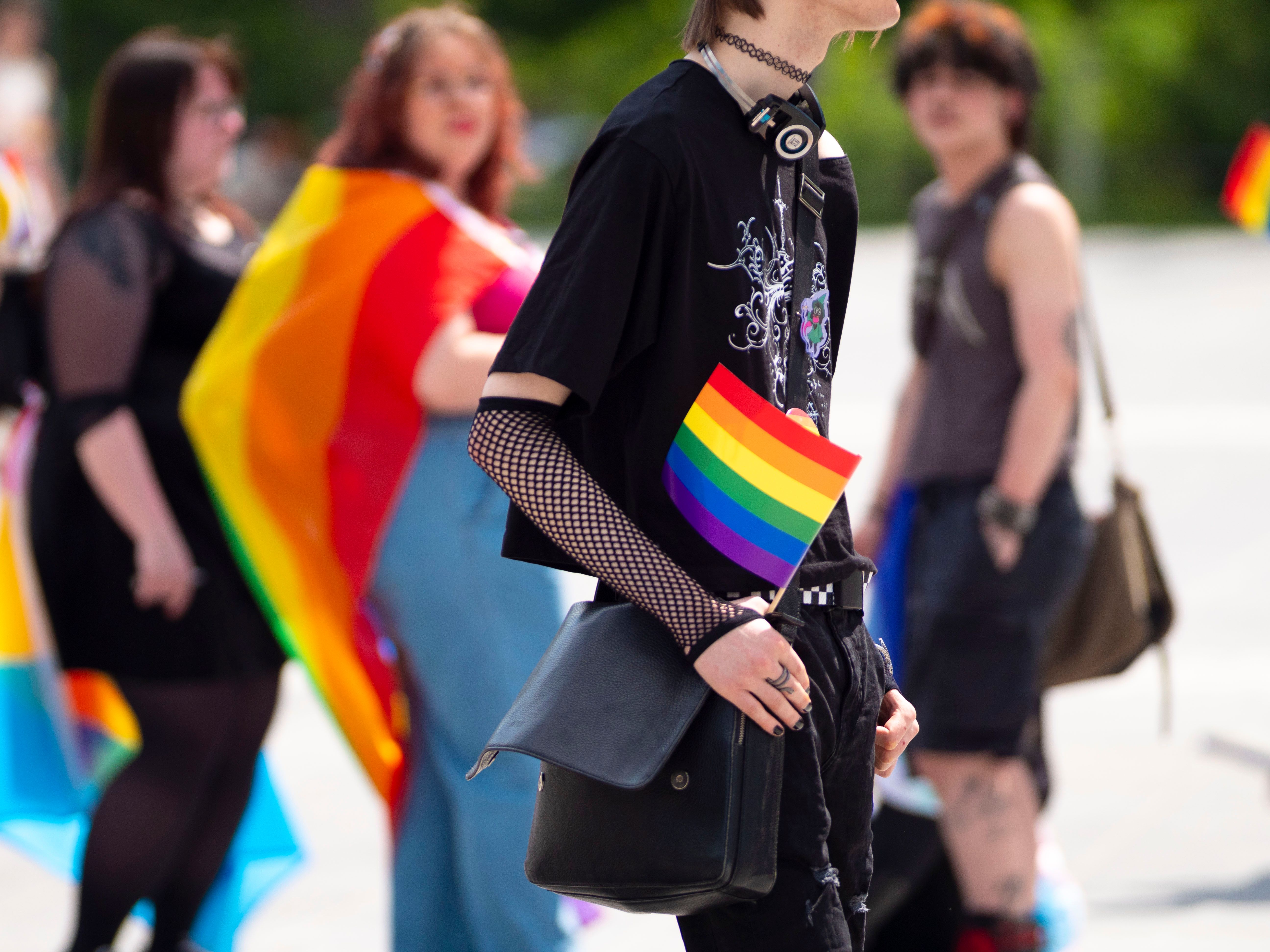
Photo by SHOX ART: https://www.pexels.com/photo/pride-celebration-in-wroclaw-poland-37862730/
Where does Satanism's record on gender fall short?
Satanism's record on gender is not uniformly progressive, and the clearest counterexample comes from LaVey himself. The Satanic Witch, published in 1971, is built on rigid gender essentialism that reads poorly now and read questionably then.
The book advances a typology of women based on physical characteristics, and a theory of erotic manipulation grounded in fixed assumptions about male and female nature. It treats femininity as a set of techniques for exercising influence over men, and it assumes a heterosexual, binary framework throughout. Its "Law of the Forbidden" and body-type system have not aged into anything defensible.
This is worth stating plainly rather than skirting. A philosophy built on individual sovereignty produced a text that tells women what they are on the basis of their measurements. The tension is real, it is internal to the tradition, and Satanists themselves raise it.
Two further criticisms recur:
Social Darwinist strands. Elements of LaVeyan thought emphasise natural hierarchy and stratification. Critics argue this sits uneasily with claims about liberation, since a philosophy of the strong is not straightforwardly a philosophy of the marginalised.
Individualism as a limit on solidarity. The Church of Satan's position on political and social questions is generally that they are matters for the individual. This produces no institutional position on gender or LGBTQ+ rights, which some members regard as principled neutrality and others as an absence where advocacy could be.
How did feminists use Satanic imagery?
Feminists used Satanic and Luciferian imagery from the nineteenth century onward as a way of reclaiming the Eden narrative, in which Eve's disobedience is reframed as the first act of intellectual courage rather than the origin of sin.
The scholarly treatment is Per Faxneld's Satanic Feminism: Lucifer as the Liberator of Woman in Nineteenth-Century Culture, published by Oxford University Press in 2017. Faxneld documents a substantial body of nineteenth-century feminist writing, art, and activism that inverted the Genesis account deliberately.
The logic of the inversion is compact. If a religious tradition has used Eve's transgression to justify the subordination of women for centuries, then celebrating that transgression attacks the justification at its root. The serpent offered knowledge. Eve took it. Everything after that is administration.
Related currents:
- Elizabeth Cady Stanton's The Woman's Bible (1895-98) reinterpreted Genesis to present Eve's choice as courageous, and was controversial enough to be repudiated by the National American Woman Suffrage Association.
- Lilith, drawn from Jewish folklore and the medieval Alphabet of Ben Sira, was adopted from the 1970s onward as a symbol of refusal, on the strength of her leaving Eden rather than submitting to Adam.
- The witch became a feminist emblem in the twentieth century, with the American group W.I.T.C.H. adopting the imagery in 1968.

Photo by Alex wolf mx: https://www.pexels.com/photo/fashion-portrait-photo-of-a-cross-dressed-guy-wearing-drag-makeup-with-red-hair-in-a-gothic-glam-rocker-style-wearing-a-pink-animal-print-headgear-forming-a-pentagram-14535591/
How does The Satanic Temple approach bodily autonomy?
The Satanic Temple treats bodily autonomy as a core religious tenet and has built much of its legal strategy around it. This is the most legally consequential intersection of Satanism with gender and sexuality in the present day.
The Third of the organisation's Seven Tenets holds that one's body is inviolable and subject to one's own will alone. Because The Satanic Temple is recognised as a church by the United States Internal Revenue Service, and because it frames this as a sincerely held religious belief, it has been able to argue for religious exemptions from laws restricting bodily autonomy.
Campaigns arising from this include:
- Reproductive rights litigation. The Satanic Temple has brought legal challenges to abortion restrictions in several US states, arguing that mandatory waiting periods, compulsory counselling, and ultrasound requirements burden its members' religious practice.
- The Religious Abortion Ritual. The organisation formalised a ritual framework around abortion access, explicitly to create a religious-freedom argument.
- Opposition to conversion therapy. Campaigns have targeted so-called conversion practices aimed at LGBTQ+ people, on the same bodily autonomy grounds.
- Corporal punishment in schools. The organisation has campaigned against physical discipline of pupils in US states where it remains lawful.
The tenets themselves are set out in the 7 Tenets of Satanism, and the organisation in what is The Satanic Temple.
Why do Satanist groups attract LGBTQ+ members?
Satanist organisations attract disproportionately high LGBTQ+ participation because they offered explicit acceptance earlier than most religious alternatives, and because the tradition's central conflict maps closely onto the experience of being told your existence is a sin.
Four contributing factors:
Early and unambiguous acceptance. The Church of Satan's position on homosexuality in 1969 was unequivocal at a point when very few religious organisations had one that was not condemnatory.
A symbolic figure defined by refusal. The Satanic figure's defining act is declining to accept a hierarchy that declares him wrong by nature. That is not a subtle parallel, and members articulate it directly.
Overlap with the goth and alternative scenes. These communities have long-standing traditions of androgyny and gender nonconformity, and the demographic overlap with Satanism is substantial. See is goth associated with any particular religious or spiritual beliefs.
Active campaigning. The Satanic Temple's public work on LGBTQ+ issues and reproductive rights functions as recruitment, whether or not it is intended that way.
The corollary is uncomfortable but worth stating: Satanism's appeal here is partly a measure of how few other places were available.

Photo by Becca Correia: https://www.pexels.com/photo/women-in-halloween-costumes-at-night-14223223/
How did the Satanic Panic target gender and sexuality?
The Satanic Panic of the 1980s and 1990s repeatedly conflated Satanism with sexual deviance, and the allegations disproportionately harmed people who were already marginalised on grounds of gender or sexuality.
The panic's standard allegation combined satanic ritual with sexual abuse of children, and the accusation was deployed against childcare workers, alternative practitioners, and people whose personal lives were considered irregular. The McMartin preschool case in California, which ran from 1983 to 1990 and became the longest and most expensive criminal trial in US history to that point, ended with no convictions. The West Memphis Three, convicted in 1994 partly on the basis of one defendant's interest in occult material and his black clothing, were released in 2011 after their convictions were successfully challenged.
The 1992 FBI report by Supervisory Special Agent Kenneth Lanning found no corroborating evidence for organised satanic ritual abuse networks. The damage, however, was distributed unevenly, and it fell hardest on people who could be presented to a jury as already suspect.
The full account is in what was the Satanic Panic.
How do the major Satanist paths compare on gender and sexuality?
|
Path |
Official position on LGBTQ+ rights |
Approach to gender |
Campaigning activity |
|---|---|---|---|
|
Church of Satan |
Sexual freedom affirmed since 1969; no political positions taken |
Individualist; no institutional doctrine |
None by policy |
|
The Satanic Temple |
Active support; bodily autonomy is a core tenet |
Explicitly inclusive |
Extensive legal and public campaigning |
|
Temple of Set |
Not a doctrinal matter |
Individualist |
None |
|
Theistic Satanism |
Varies widely by individual and group |
Varies |
Minimal |
|
Luciferianism |
Generally affirming |
Often draws on androgynous symbolism |
Minimal |
The split is clear. The Church of Satan's position is that sexual freedom is a matter of personal sovereignty and that organisations should not campaign. The Satanic Temple's position is that sexual and bodily freedom are religious commitments that require defending in public. Both positions descend from the same libertarian root and have arrived somewhere very different.
FAQ
Is Baphomet male or female? Neither, deliberately. Eliphas Lévi's 1856 illustration gave the figure both male and female attributes, including female breasts, as a symbol of the union of opposites. The androgyny is original to the image rather than a modern addition. Baphomet has been read as a symbol of gender nonconformity on that basis, and the reading is well grounded in Lévi's own stated intent.
Does Satanism support LGBTQ+ rights? It depends on the organisation. The Satanic Temple actively campaigns on LGBTQ+ issues, including opposition to conversion practices, as an expression of its Third Tenet on bodily autonomy. The Church of Satan has affirmed sexual freedom since 1969 but declines to take institutional political positions of any kind. Individual Satanists across all paths are overwhelmingly supportive.
Why is Lilith associated with feminism? Lilith appears in the medieval Jewish text the Alphabet of Ben Sira as Adam's first wife, who leaves Eden rather than accept a subordinate position. From the 1970s onward, feminist writers adopted her as a symbol of refusal to submit. She is not originally a Satanic figure, though she has been incorporated into some theistic Satanist and Luciferian frameworks.
What is Satanic feminism? Satanic feminism refers to the use of Satanic and Luciferian imagery by feminist writers, artists, and activists, particularly in the nineteenth century, to reframe Eve's disobedience in Eden as an act of intellectual courage rather than sin. The definitive scholarly study is Per Faxneld's Satanic Feminism, published by Oxford University Press in 2017.
Is The Satanic Witch still recommended reading? It remains in print and is still sold by the Church of Satan, but it is widely criticised, including within Satanism, for gender essentialism that has not aged well. Its typology of women by body type and its assumptions about heterosexual dynamics conflict with the individualist philosophy the movement otherwise professes. Readers generally encounter it as a historical document rather than a guide.
Do Satanists have particular views on marriage? No unified position. The Church of Satan performed same-sex weddings from the early 1970s, long before legal recognition. The Satanic Temple ordains ministers who conduct weddings where legally permitted. Both treat marriage as a personal choice rather than a religious obligation, and neither attaches doctrinal significance to monogamy.
Why is the witch a feminist symbol rather than a Satanic one? It is both, in different contexts. The historical witch trials targeted women disproportionately, which made the figure available as a symbol of state and religious persecution of women. Feminist groups adopted it directly, including the American organisation W.I.T.C.H. in 1968. The overlap with Satanism comes from the Christian framing of witchcraft as devil-worship, which was a theological claim rather than a description of what accused women actually did.
However you carry your politics, our gothic pins, gothic patches, and 3 for £12 accessories say it without you having to open the conversation yourself.