Skip to content


What Are the Techniques Goths Use to Express the Dark Romantic Aesthetic?
Goths express the dark romantic aesthetic through a mix of Victorian-inspired fashion, dramatic monochrome makeup, moody home décor, Gothic literature, evocative music, atmospheric photography, symbolic tattoos, and small daily rituals that treat ordinary life as slightly more theatrical than it needs to be. The aesthetic sits at the intersection of goth culture and 19th-century Romanticism, and it is expressed through habits and choices, not just clothes.
Key Takeaways
- Dark romantic goth blends Victorian mourning fashion, Gothic literature, and post-punk melancholy into one visual and cultural language.
- The core techniques are fashion, makeup, interior décor, music, literature, photography, tattoos, and daily lifestyle habits.
- Silhouette matters more than logo. Lace, velvet, high collars, corseted lines, and long drapes signal dark romantic faster than any band T-shirt.
- The makeup vocabulary is small but precise: pale foundation, dark lip, sharp brow, defined eye, and no visible flush.
- Dark romantic is closer to Victorian goth and romantic goth than to trad goth, cyber goth, or nu goth.
- It is a lifestyle aesthetic, not just a wardrobe. Books, music, home, and the way you spend a Sunday afternoon all count.
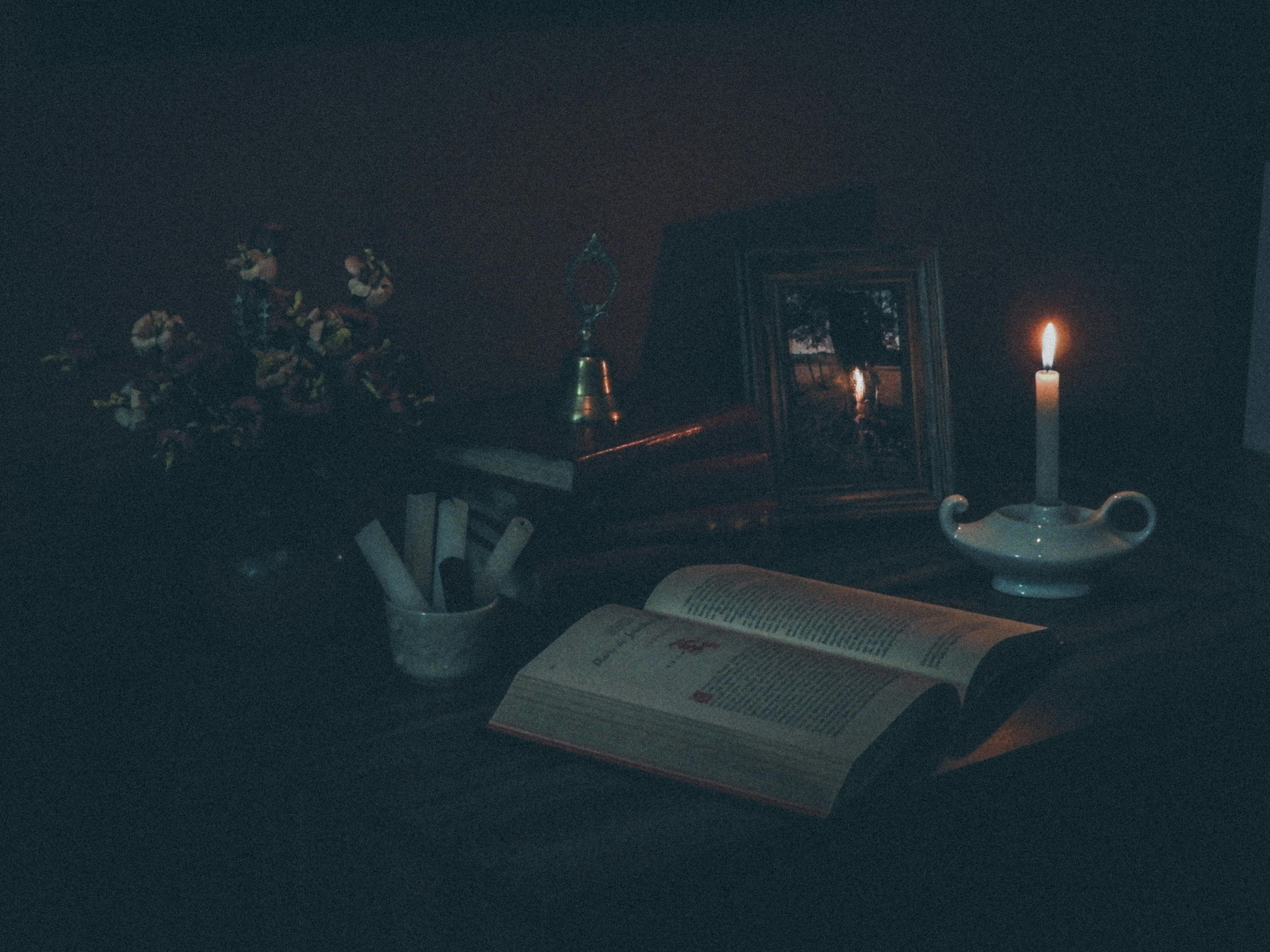
Photo by Renan Martini from Pexels: https://www.pexels.com/photo/white-book-page-with-lighted-candle-14486102/
What is the dark romantic aesthetic in goth culture?
The dark romantic aesthetic in goth is a style that draws on 18th and 19th-century Romanticism, Gothic literature, and Victorian mourning culture, filtered through modern goth sensibility. It leans into beauty, melancholy, mortality, longing, and decay, and it does so with elaborate visual language rather than shock tactics.
It is not the same as trad goth, which is rooted in post-punk music. It is not the same as Victorian goth, which insists on historically accurate silhouettes. It sits closer to romantic goth, but wider, because dark romantic reaches into interior design, photography, and lifestyle in a way romantic goth does not always bother with.
Think of the dark romantic aesthetic as goth culture in conversation with Edgar Allan Poe, Mary Shelley, the Pre-Raphaelites, and every candlelit oil painting of a woman staring wistfully out of a window. If you want the wider context of where this sits, goth culture as a whole gives it its foundation, and the Gothic literary genre gives it its emotional grammar.
What are the main fashion techniques of the dark romantic aesthetic?
Dark romantic fashion is defined by silhouette, texture, and restraint of colour. The pieces themselves are not complicated. What makes them read as dark romantic is how they are combined and worn.
Silhouette: High collars, corseted or fitted waists, long sleeves, floor-length skirts, trailing drapes. The line of the outfit is closer to a Victorian mourning portrait than to a modern trend cycle. Trousers exist in the dark romantic wardrobe, but they lean toward high-waisted, sharply cut, and formal.
Texture: Velvet, lace, satin, silk, brocade, tulle, and heavy black wool are the core fabrics. Cheap stretch cotton undoes the aesthetic instantly. Texture is what carries the mood when the colour palette is stripped back.
Colour: Black leads, but dark romantic is not exclusively monochrome. Deep burgundy, oxblood, aubergine, forest green, ink navy, and antique cream all sit within it. Bright colours are avoided. Pastels are for pastel goth, which is a different conversation.
Accessories: Cameos, mourning brooches, jet jewellery, chokers, pearl chokers, lockets, antique keys, veils, gloves, and pocket watches. Rings on every finger is not overkill in this aesthetic. It is standard.
Footwear: Ankle boots with a heel, pointed Victorian-style boots, ballet flats in dark leather, and lace-up granny boots. Chunky platforms belong more to trad goth and nu goth than to dark romantic.
The point is not to look like a Victorian re-enactor. It is to signal that same emotional register - restraint, melancholy, refinement - through modern clothes.

Photo by Natasha Babenko from Pexels: https://www.pexels.com/photo/purple-cluster-petaled-flower-2565347/
What are the main makeup techniques of the dark romantic aesthetic?
Dark romantic makeup is a small, precise vocabulary that most practitioners can build in ten minutes. It is not about drama in the theatrical sense. It is about looking like a slightly haunted painting.
The core techniques are:
- Pale skin. Foundation is applied one to two shades lighter than the natural complexion. Blush is minimal or absent. The goal is a still, cool-toned base, not a healthy glow.
- Defined brows. Sharp, arched, and slightly heavier than the natural shape. The brow does a lot of emotional work in this look.
- Deep eye. Smoky, softly blended shadow in charcoal, black, plum, or oxblood. Eyeliner is present but not always sharp. A slightly smudged line reads more romantic than a wing.
- Dark lip. Berry, oxblood, plum, or a matte true black are the classic dark romantic lips. Bright red is optional and belongs more to a vintage pin-up crossover.
- Contour and cheekbone. A cool-toned contour under the cheekbone gives the "portrait" look. Warm bronzer breaks the aesthetic.
Nail varnish is usually black, dark red, deep purple, or unpolished. Long nails are common. Chipped varnish is not seen as a mistake, it is part of the language.
Full breakdown of how goths in general treat makeup, hair, and body modification is covered in the dedicated article on fashion, makeup and body modification.
How do goths express the dark romantic aesthetic at home?
Dark romantic goths bring the aesthetic into the home through lighting, materials, décor, and the deliberate use of objects that reference the 19th century. The home is treated as an extension of the wardrobe.
Common techniques include:
- Lighting: Warm, low, and localised. Candles, antique table lamps, wall sconces, and stained glass shades. Overhead lighting is avoided or dimmed.
- Colour palette: Deep jewel tones, muted plums, burgundies, forest greens, aged golds, and inky blacks. White walls are painted over or covered with prints.
- Furniture: Dark wood, velvet upholstery, wingback chairs, chesterfields, four-poster beds, and antique writing desks. Second-hand and inherited pieces are prized.
- Objects: Framed botanical prints, taxidermy or bone replicas, apothecary bottles, tarot cards, curiosity cabinets, old books, dried flowers, and mirrors with tarnished frames.
- Scent: Beeswax candles, sandalwood, frankincense, myrrh, patchouli, and dried herbs. Fresh floral sprays and citrus air fresheners are not in the register.
The overall goal is a space that looks like it was inherited from a slightly eccentric ancestor. If a room could plausibly appear in a Pre-Raphaelite painting, the aesthetic is working.
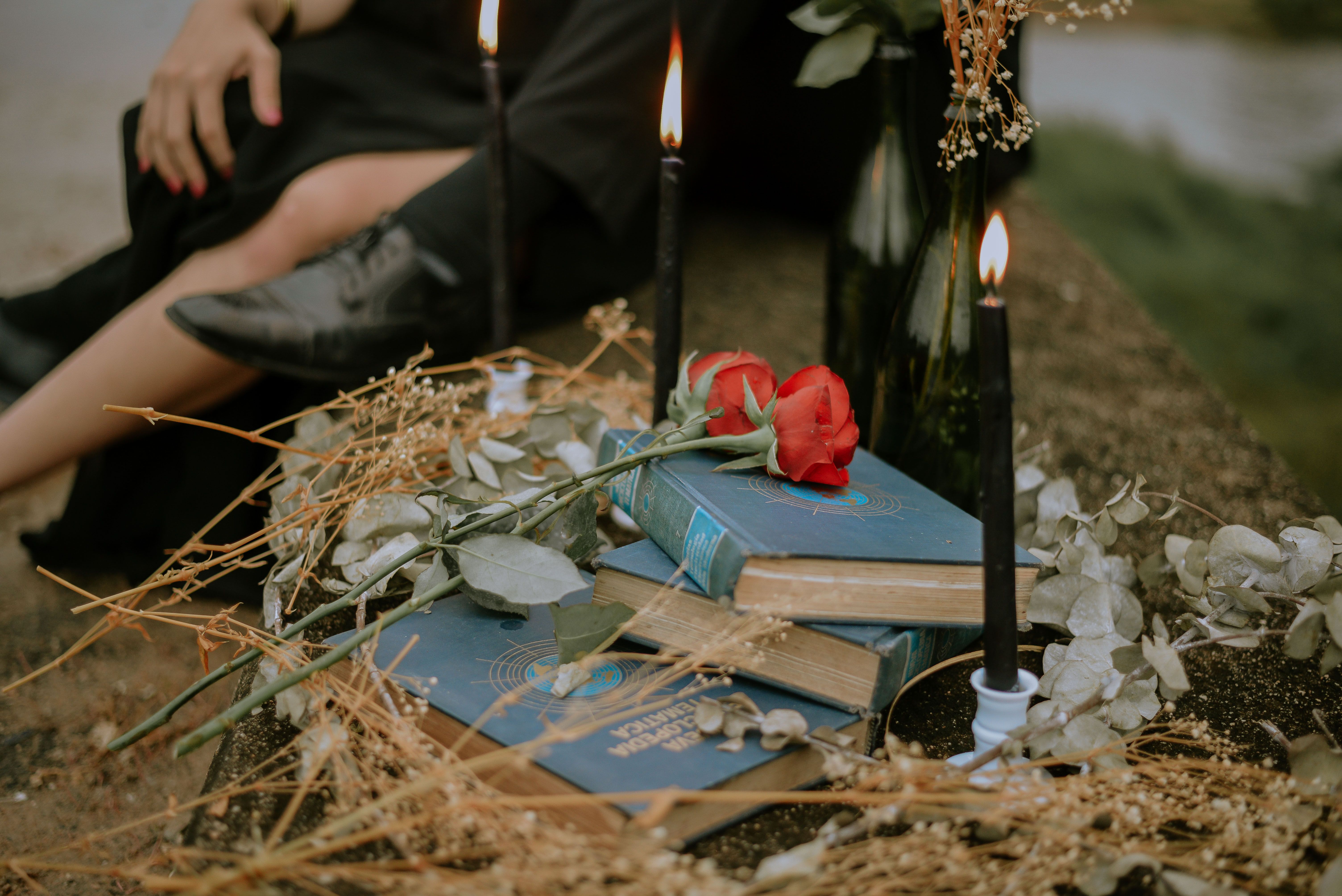
Photo by Luis Zambrano from Pexels: https://www.pexels.com/photo/wax-candles-and-roses-on-books-10030159/
What role does music play in the dark romantic aesthetic?
Music is essential to the dark romantic aesthetic and often runs quietly behind the visual style rather than defining it directly. The relevant genres are gothic rock, darkwave, dream pop, ethereal wave, neoclassical darkwave, dark folk, and neofolk.
Key artists include Cocteau Twins, Dead Can Dance, Lycia, Black Tape for a Blue Girl, Faith and the Muse, Chelsea Wolfe, and This Mortal Coil. The Cure and Siouxsie and the Banshees provide the trad goth spine. Bauhaus and Sisters of Mercy sit at the more direct post-punk end.
Musical taste is not gatekept in dark romantic in the way it sometimes is in trad goth, but a dark romantic playlist that contains only pop from the last five years will read as thin. The historical spine matters. If you want the full story of how the music scene evolved, that is worth reading alongside.
Live music is a technique as well. Attending gigs, club nights, and festivals in the darkwave and gothic rock circuit is how dark romantic goths sustain the aesthetic as a lived thing rather than a photo-shoot vibe. The full picture of rituals, gatherings, and community spaces belongs here.
How does Gothic literature shape the dark romantic aesthetic?
Gothic literature is one of the foundational references for dark romantic goth. Reading it, quoting it, and displaying it in the home are all core techniques.
The essential canon includes Mary Shelley's Frankenstein, Edgar Allan Poe's poems and short stories, Bram Stoker's Dracula, Emily Brontë's Wuthering Heights, Ann Radcliffe's The Mysteries of Udolpho, Sheridan Le Fanu's Carmilla, and later work such as Anne Rice's Interview with the Vampire. Angela Carter, Shirley Jackson, and Daphne du Maurier extend the tradition into the 20th century.
Reading is treated as a lifestyle habit, not a chore. A dark romantic goth is more likely to read on a train, in a candlelit corner, or in a graveyard than in a gym. Copies of these books are often displayed openly on shelves, with older or leather-bound editions treated as design objects.
Poetry sits inside this too. Coleridge, Keats, and Christina Rossetti are frequently quoted, tattooed, and hand-written into journals. If a dark romantic aesthetic goth has an Instagram caption, there is a reasonable chance it started life as a Keats fragment.
What are the visual arts of the dark romantic aesthetic?
The visual reference points for dark romantic goth are Pre-Raphaelite painting, Romantic-era landscape painting, Symbolist art, and Victorian mourning photography. These references appear on walls, in tattoos, in phone wallpapers, and in the general "mood" of the aesthetic.
Painters commonly cited include John William Waterhouse, Dante Gabriel Rossetti, John Everett Millais, Caspar David Friedrich, Henry Fuseli, and Odilon Redon. Waterhouse's The Lady of Shalott and Millais's Ophelia are the two paintings you can expect to see referenced repeatedly.
Photography follows the same emotional register. Dark romantic photography often uses natural light, cold tones, single-figure composition, isolated landscapes, and either historical costume or a modern outfit that reads as timeless. Grain is preferred to over-sharp digital. There is a full separate treatment of the visual arts and media that goth draws from, which extends this further.
How do tattoos express the dark romantic aesthetic?
Dark romantic tattoos favour fine-line black work, Victorian illustration styles, botanical motifs, portraiture, and literary references. Colour is rare. Bold traditional flash is avoided.
Common motifs include roses, moths, snakes, ravens, skulls, keys, moons, hands holding candles, mourning brooches, memento mori still lifes, and quotations in serif or copperplate script. Tattoos often reference Gothic literature directly - lines from Poe, images from Dracula, or Ophelia in the water.
Placement tends toward the classical: the sternum, the ribs, the collarbone, the inner arm, the back of the neck, the thigh. Full sleeves are less common in dark romantic than in traditional or American traditional goth aesthetics. When they do appear, they read as an illuminated manuscript rather than a comic panel.
What daily rituals and lifestyle habits sustain the aesthetic?
Dark romantic is a lifestyle aesthetic, and the small daily habits are as important as the wardrobe. This is what separates a considered aesthetic from a costume.
Common habits include:
- Keeping a handwritten journal, ideally in a hardback notebook with a cloth or leather cover.
- Loose-leaf tea, prepared in a proper pot, drunk from a cup with a saucer.
- Long walks in cemeteries, ruins, moors, forests, or gardens with wrought iron gates.
- Reading physical books rather than only using a phone.
- Letter-writing, sometimes with a fountain pen.
- Tarot, tea leaves, or another divinatory practice - not always as belief, sometimes as reflective ritual.
- Regularly visiting museums, cathedrals, and antique fairs.
- A skincare and grooming routine treated as a small nightly ceremony.
None of these is required. A dark romantic goth is not disqualified for having Netflix. But the general shape of the day is slower, more textured, and more attentive to atmosphere than the mainstream default. For those whose dark romantic overlaps with spirituality, the practical rituals covered elsewhere are worth reading.
How to build a dark romantic aesthetic (step by step)
If you want to build a dark romantic aesthetic from scratch, the sequence below is a workable starting point. It is not the only path, but it is one that consistently works.
- Start with the wardrobe silhouette. Buy one high-collar blouse, one long black skirt or dress, one pair of pointed ankle boots, and one long coat. All black. This gives you a working base.
- Add texture. Add lace, velvet, and one piece with a corseted line. Second-hand shops are the cheapest and best source. Fast-fashion versions rarely have the fabric weight the aesthetic needs.
- Learn five makeup steps. Pale base, defined brow, dark eye, dark lip, contoured cheek. Practise until you can do all five in ten minutes.
- Build a music library. Start with Bauhaus, The Cure, Siouxsie and the Banshees, Cocteau Twins, Dead Can Dance, and Chelsea Wolfe. Add outwards from there.
- Read the canon. Frankenstein, Dracula, one Poe collection, Wuthering Heights. Buy them second-hand if possible. Physical copies matter.
- Adjust one room. Change the lighting. Add candles. Frame one piece of Pre-Raphaelite or Symbolist art. Replace fluorescent bulbs with warm ones.
- Add jewellery. Rings, chokers, cameos, and lockets. Silver and antiqued brass read better than yellow gold in this aesthetic.
- Build a lifestyle habit. Pick one - journal, tea ceremony, letter-writing, cemetery walk - and do it weekly.
By the time you are three months in, the aesthetic will start to look like a life rather than a photo shoot.
Dark romantic vs other goth sub-genres
The dark romantic aesthetic is one of many recognised styles within goth. The full guide to sub-genres is the wider map, but the short comparison below gives a working sense of where dark romantic sits.
|
Aesthetic |
Core reference |
Fabrics |
Colour palette |
Music focus |
|---|---|---|---|---|
|
Dark Romantic |
Pre-Raphaelite art, Gothic literature |
Velvet, lace, silk |
Black, burgundy, oxblood, aubergine |
Darkwave, dream pop, gothic rock |
|
Romantic Goth |
Anne Rice, doomed love |
Velvet, lace |
Black, deep red, purple |
Darkwave, ethereal wave |
|
Victorian Goth |
Historical Victorian dress |
Wool, brocade, jet |
Black, jet, deep grey |
Orchestral, atmospheric |
|
Trad Goth |
Post-punk 1979-83 |
Cotton, leather, fishnet |
Black, occasional red |
Bauhaus, The Cure, Sisters of Mercy |
|
Nu Goth |
Occult minimalism |
Cotton, wool |
All black |
Witch house, dark pop |
Dark romantic overlaps most heavily with romantic and Victorian goth. If someone tells you they cannot tell the three apart, that is fair. The difference is often about which reference the person foregrounds - painting, literature, or historical fashion.
Common mistakes when building the aesthetic
Some techniques undo the aesthetic faster than others. The most common problems are worth naming plainly.
Over-accessorising. Every finger with a chunky ring, every wrist stacked, every neck loaded. The dark romantic aesthetic is drawn from mourning culture. Restraint is part of the language.
Fast fashion textures. Polyester lace and stretch velvet read as costume, not aesthetic. One well-made piece is worth ten cheap ones.
Wrong lighting. Cool overhead LEDs kill the aesthetic in any room. Warm, low, localised light is non-negotiable.
Costume aesthetic without lifestyle. If the wardrobe is dark romantic but the phone is full of gym selfies and reality TV, the aesthetic reads as costume. It does not have to be pure - nothing does - but there should be a lived thread.
Confusing it with Halloween. Halloween is one night. Dark romantic is a way of getting dressed on a Tuesday in March.
FAQ
Is dark romantic goth the same as romantic goth? No. Romantic goth is a specific sub-genre focused on doomed love, Gothic literature, and elaborate romantic imagery. Dark romantic is a broader aesthetic that includes fashion, interiors, art, and lifestyle habits. Every romantic goth could fairly be called dark romantic, but not every dark romantic person identifies as a romantic goth.
Do I have to listen to gothic rock to be part of the dark romantic aesthetic? Ideally, yes. The aesthetic sits inside goth culture, and goth culture began as a music-led movement. You do not have to know every B-side, but a dark romantic aesthetic without any grounding in the music tradition is fragile. Start with Cocteau Twins, The Cure, and Chelsea Wolfe if you are new.
Is dark romantic goth expensive? It does not have to be. Second-hand shops, charity shops, and vintage markets are the main sources. The aesthetic favours older, textured, well-made pieces over trend-driven fast fashion, which usually means paying less overall for clothes that last longer.
Can men wear the dark romantic aesthetic? Yes. Male dark romantic style leans on Victorian tailoring, high collars, waistcoats, cravats, long coats, and dramatic outerwear. Byron is a useful reference point. The androgyny of goth culture means most pieces are worn across gender lines anyway.
What's the difference between dark romantic and dark academia? Dark academia is oriented around universities, ancient languages, classical education, and 20th-century tweed. Dark romantic is oriented around Romanticism, Gothic literature, and Victorian mourning. They overlap around books, candles, and moody photography, but the core references are different.
Do I need tattoos or piercings to do this aesthetic? No. Body modification is common in goth culture, but the dark romantic aesthetic is expressed just as effectively through fashion, makeup, home, and lifestyle. Tattoos are one technique, not a requirement.
How do I know if it's working? A workable test: if someone described your outfit, room, or reading list as looking like it came out of a Pre-Raphaelite painting or a Gothic novel, the aesthetic is landing. If people describe it as "spooky" or "Halloween," you have leaned too far into shock and not far enough into refinement.
Whether your dark romantic aesthetic sits at the mourning end or the Pre-Raphaelite end, our occult necklaces, gothic earrings, and gothic patches are an easy way to carry the symbolism into everyday life.