Skip to content

What are the Key Elements of Wiccan Spellcasting?
The key elements of Wiccan spellcasting are focused intention, careful timing, a prepared sacred space, the elements, ritual tools, natural correspondences, raised energy, and an ethical framework that keeps the whole thing honest.
That is the checklist. The interesting part is how those pieces fit together, because a spell is not a shopping list of props. It is a system, and every part has a job. Get the system right and the practice makes sense. Treat it as a collection of random objects and candles, and you have missed the point entirely.
There is no single rulebook here. Wicca has many traditions, and solitary witches make up their own way of doing things all the time. But certain elements turn up again and again, across covens and kitchen tables alike. Those are what this article covers.
Key Points
- Intention is the engine of a spell. Everything else exists to support it.
- Timing matters. Moon phases and the seasons of the Wheel of the Year are the most common guides.
- The circle creates a focused, protected space to work in.
- The elements, tools, and correspondences help direct and shape the energy.
- Raising and releasing energy is the heart of the working.
- The Wiccan Rede and the Threefold Law act as the ethical brakes.
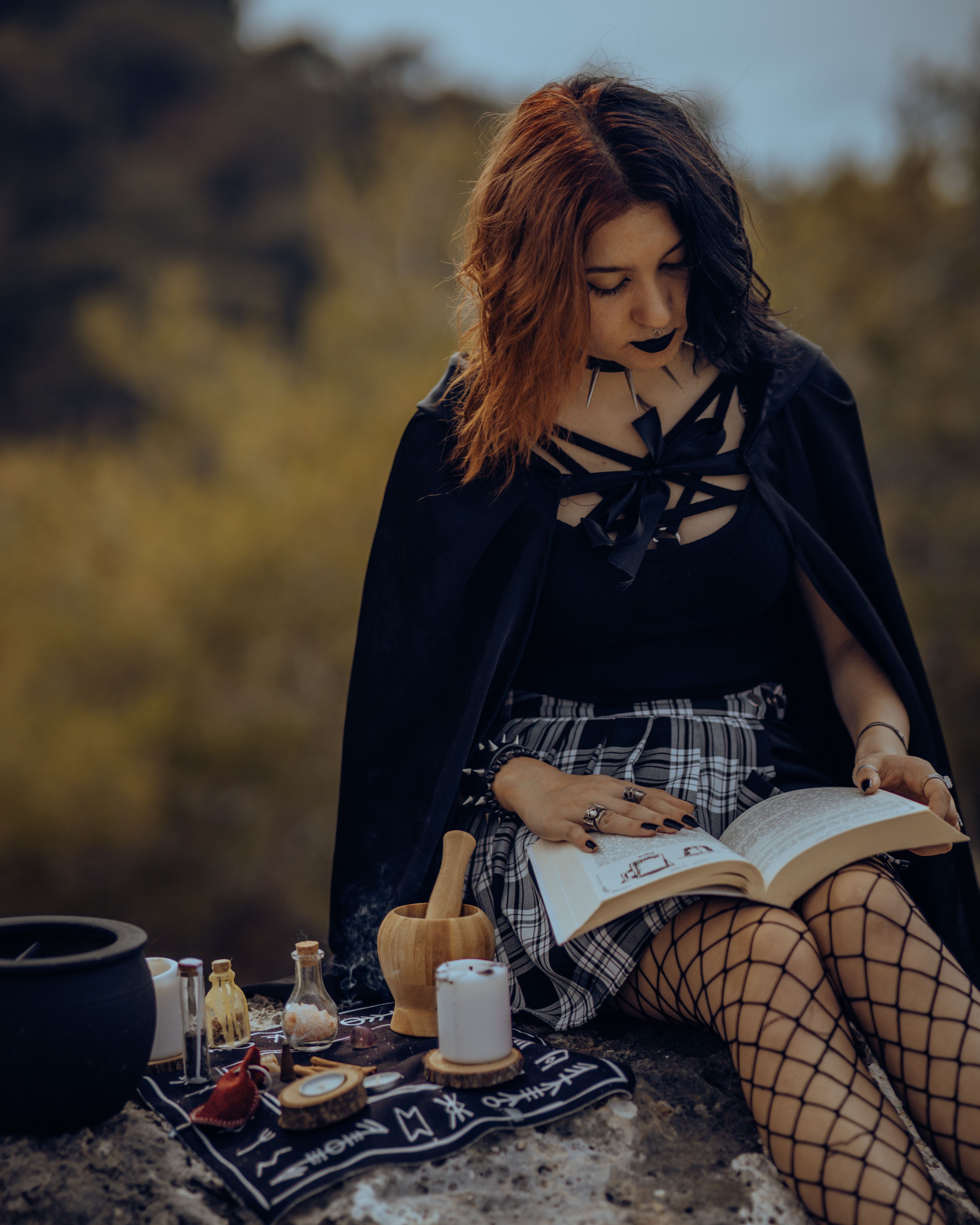
Photo by UMUT 🆁🅰🆆 from Pexels: https://www.pexels.com/photo/woman-reading-a-spell-book-and-sitting-next-to-candles-and-pots-16926689/
What Wiccan Spellcasting Actually Is
A spell is focused intention, backed by energy and ritual, aimed at causing a change.
That is the whole idea in one sentence. A Wiccan decides what they want to happen, raises energy, and directs it toward that goal. The ritual around it - the candles, the words, the timing - is there to sharpen focus and lend power, not to perform stage magic.
This is where a lot of people get the wrong idea about magic. Spellcasting is not waving a wand and watching reality rearrange itself. It is closer to prayer mixed with intense concentration and symbolic action. Many Wiccans also weave their gods into the work, asking the Goddess or the God for help rather than commanding the universe alone.
And practice varies enormously. A coven spell can be a formal, scripted rite with robes and tools. A solitary witch might light a single candle at the kitchen sink and mean it just as hard. Both count. Anyone who tells you there is one correct way to cast is selling you their way, not the truth.
Intention and Will
If you take only one thing from this article, take this: intention is everything.
A spell with no clear intention is just a person fiddling with herbs. The witch has to know exactly what they want, hold it in their mind, and pour real feeling into it. Vague wishes get vague results. "I want things to be better" is weak. "I want to feel calm and confident before my interview on Thursday" is strong, because the mind can lock onto it.
This is why I have little patience for the idea that you need an expensive altar to cast well. You do not. A focused witch with nothing but their own will beats a distracted one surrounded by crystals every single time. The tools help. The will does the work.
Concentration, visualisation, and emotion are the three muscles being trained here. See the goal clearly. Feel it as though it has already happened. Hold that without your mind wandering off to your shopping list. That is harder than it sounds, and it is the real skill behind everything else.
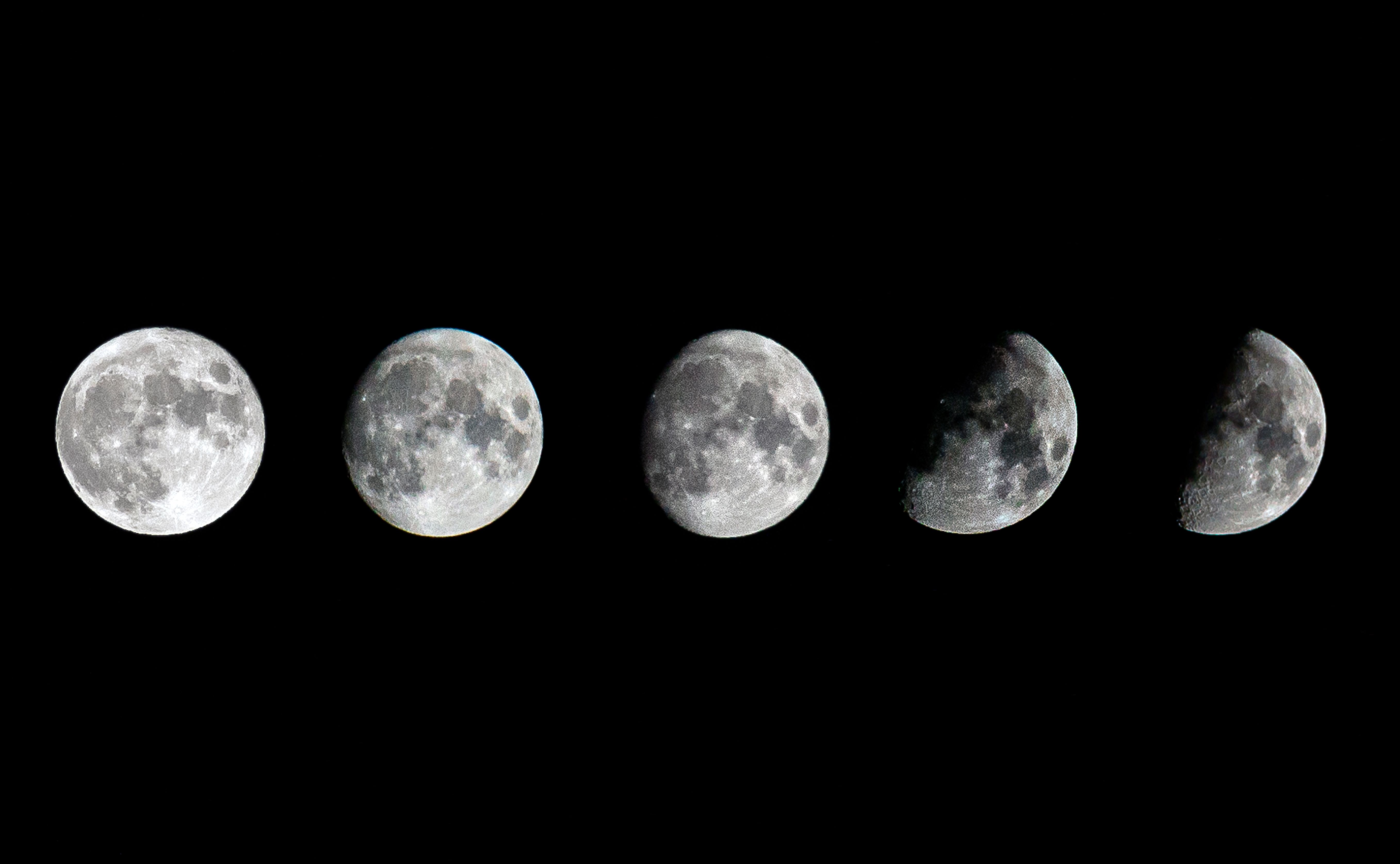
Photo by Sid Ali from Pexels: https://www.pexels.com/photo/phases-of-the-moon-display-on-black-background-37773914/
Timing: Moon Phases and the Wheel of the Year
Most Wiccans believe that when you cast matters, and the moon is the usual clock.
The logic is simple and follows the moon's own rhythm. A waxing moon, growing fuller each night, suits spells for growth, attraction, and drawing things in. The full moon is the peak, the moment of greatest power, good for almost any major working. A waning moon, shrinking back, suits banishing, releasing, and clearing things away. The dark moon, when no moon shows, is often kept for rest, reflection, and deeper inner work.
On top of the moon sits the Wheel of the Year, the cycle of eight seasonal festivals. Each carries its own mood and themes, so a spell cast at one of them can borrow the energy of the season - renewal in spring, abundance at harvest, and so on.
Some witches add another layer, matching spells to days of the week and their planetary rulers. Friday for love, Tuesday for courage, that sort of thing. It is a nice touch if you enjoy it.
But here is my honest take. Timing is a helpful tool, not an iron law. If you need protection tonight and the moon is wrong, cast anyway. A spell cast with real urgency and focus on the "wrong" day beats a half-hearted one cast on the "right" one. Do not let a calendar talk you out of acting when it counts.
Sacred Space and the Circle
Before serious spellwork, most Wiccans cast a circle.
The circle is a ring of energy the witch creates around their working space, usually by walking the boundary and visualising a sphere of light. It does a few jobs at once. It marks the space as sacred and set apart from ordinary life. It contains the energy being raised so it can build up rather than leak away. And it acts as a shield, keeping out unwanted influences while the witch is open and focused.
Before casting it, the space is usually cleansed, often with incense, salt, or a simple sweep with a broom meant to clear stale energy rather than dust.
People sometimes roll their eyes at this part, and I understand why. From the outside it can look like theatre. But there is something real going on, even if you strip out the supernatural claims. Drawing a circle tells your brain that you have crossed from everyday mode into focused mode. That mental shift is genuinely useful, and it is half the reason the circle works at all.
The Elements and the Quarters
Wiccan spellcasting leans heavily on the five elements: earth, air, fire, water, and spirit.
The first four are tied to the four compass directions, often called the quarters. Many spells begin by "calling the quarters," inviting the powers of north, east, south, and west into the circle. Each element brings its own quality to a working. Earth is stability, money, and the body. Air is thought, communication, and new ideas. Fire is passion, courage, and willpower. Water is emotion, love, and healing. Spirit is the fifth, the thread that binds the other four together and links the witch to the divine.
When a witch wants to strengthen a particular goal, they reach for the matching element. A money spell leans on earth. A spell to win an argument leans on air. This is not random. It gives the working a clear shape and tells the witch which energies to draw on.

Photo by RDNE Stock project from Pexels: https://www.pexels.com/photo/close-up-shot-of-a-person-holding-a-wand-7978137/
Ritual Tools
The classic Wiccan tools each have a role, and there are a handful you will meet everywhere.
The athame is a ritual blade, used to direct energy and cast the circle, not to cut anything physical. The wand also directs energy and calls in power. The chalice holds water or wine and stands for the element of water and the Goddess. The pentacle, a disc marked with a five-pointed star, represents earth and acts as a surface for blessing objects. The cauldron is a vessel for mixing, burning, or holding water. Candles appear in almost every spell. And the altar is the table that holds it all.
Here is the thing worth repeating, though, because it gets forgotten. Tools do not contain magic. They focus and direct it. They are props for the mind, ways of making intention solid and giving the hands something to do. A witch can cast perfectly well with none of them. If you cannot afford a silver athame, point your finger. It works just as well, because the power was never in the knife.
Correspondences: Colours, Herbs, and Crystals
Correspondences are the system of matching materials to intentions, and they are everywhere in spellwork.
Colour is the easiest example. A green candle for money and growth, red for love and passion, white for protection and purity, black for banishing and absorbing negativity. Herbs carry their own associations - rosemary for memory and protection, lavender for calm, basil for prosperity. Crystals join in too, with rose quartz for love, amethyst for peace, black tourmaline for shielding. Oils and incense work the same way, each scent tied to a purpose.
The idea is that these materials carry natural energies that line up with the goal and strengthen the spell. A money spell built from green candles, basil, and a coin simply pulls harder in one direction.
My view is that correspondences do real work, but maybe not for the reason people think. Surrounding yourself with objects that all point at the same goal hammers that goal into your focus. The green candle reminds you. The basil reminds you. By the time you cast, your whole mind is pointed one way. Whether the herbs hold cosmic power or simply train your attention, the result is a sharper spell either way.
Words, Chants, and Incantations
Most spells are spoken, and the words are not just decoration.
A witch states their intention out loud, often as a chant, a rhyme, or a short invocation repeated several times. Rhyme and rhythm are popular for a good reason. A repeated, rhyming phrase is easy to hold in the mind, it builds a hypnotic focus, and it helps raise energy through repetition. Saying a goal aloud also makes it feel real and committed in a way that thinking it never quite does.
That said, the words do not have to be old or fancy or borrowed from a book. Plenty of witches improvise, speaking plainly from the heart, and some work in total silence. The power is in the meaning and focus behind the words, not in clever poetry. Do not get hung up on sounding like a film witch.
Raising and Directing Energy
This is the heart of the whole practice, the moment a spell actually happens.
Raising energy means building up a charge of personal and spiritual power inside the circle. Witches do this in different ways: chanting, drumming, dancing, rhythmic breathing, or intense visualisation. The body and mind work together to wind the energy up tighter and tighter. In group rituals this build-up is sometimes pictured as a "cone of power," a swirling peak of energy rising from the circle.
Then comes the release. At the peak, the witch directs all that built-up energy at the goal, sending it out with a final word, gesture, or push of will. Picture an archer drawing a bow and firing the arrow. The drawing back is the raising; the release is the casting.
And there is a crucial last step that beginners often miss. After releasing, you let go. You stop gripping the outcome, stop checking every hour to see if it worked. Holding on too tightly is believed to drag the energy back. Cast it, mean it, then release it and get on with your life.
Spell Components
Beyond tools, spells often use physical objects that carry the intention, and these are where spellcraft gets creative.
A written petition, the goal scribbled on paper and then burned or buried, is one of the simplest. Sigils are symbols a witch designs to stand for a desire. Poppets are small dolls that represent a person, used in healing or, less kindly, in baneful work. Knot and cord magic ties intention into literal knots to be released later. Charm bags hold herbs, stones, and tokens to be carried or hidden. Offerings of food, drink, or flowers thank the gods for their help.
These objects act as anchors. They give the spell a physical home, something to focus on during the working and something to keep, burn, or bury afterward. A spell you can hold in your hand feels more real than one that lives only in your head, and that feeling matters.
The Book of Shadows
Serious witches keep a record of their practice, and that record is the Book of Shadows.
It is a personal notebook of spells, rituals, results, correspondences, and reflections. Some are inherited or copied within a tradition; many are built from scratch over years. The point is partly practical: by writing down what you did and what happened, you learn what actually works for you and what does not. Magic without records is just guessing in the dark, repeated forever.
It is worth being clear that the Book of Shadows is not a fixed holy book like the Bible. There is no single official version. It is a working journal, and yours will be different from everyone else's. That is exactly how it should be.
Ethics: The Rede and the Threefold Law
No honest account of Wiccan spellcasting can skip the ethics, because they shape what many witches will and will not cast.
Two ideas dominate. The Wiccan Rede boils down to harming none. The Threefold Law warns that whatever energy you send out comes back to you three times over. Together they make most Wiccans cautious about harmful magic, since cursing someone is meant to rebound on the caster threefold.
The thorniest question is consent. Is it right to cast a spell on another person without their knowledge, even a "nice" one? Plenty of witches say no. A love spell aimed at a specific person, for instance, overrides their free will, and a lot of practitioners treat that as flatly wrong, kind intentions or not. Healing spells sent to a sick friend sit in a greyer area.
My own position is firm on this point. Magic aimed at controlling another person, however sweetly you dress it up, is the kind of thing that should give you pause. Cast to change yourself and your own circumstances first. That is where your real power sits anyway.
Grounding and Closing
When the work is done, you do not just walk away. You close it down properly.
Closing the circle reverses the opening. The witch thanks and dismisses the quarters and any deities they called, then opens the circle they cast, releasing the boundary. After an intense working, a witch usually grounds as well, sending leftover energy down into the earth, often by eating something, touching the floor, or simply taking a few breaths and coming back to the room.
Skipping this leaves you frazzled and the space unsettled, a bit like leaving the gas on after cooking. Grounding closes the loop and brings you back to ordinary life. It is the least glamorous part of spellcasting and one of the most important.
Common Mistakes and Misunderstandings
A few errors trip up newcomers again and again, and they are easy to name.
The first is expecting spells to be instant and guaranteed. They are not. Magic tends to work through ordinary channels - an opportunity appears, a mood shifts - and it can take time, or simply not work at all.
The second is thinking more tools and ingredients mean more power. They do not. Focus beats clutter, every time.
The third is believing you must follow a tradition to the letter or it will fail. You do not. The core principles matter; the exact script does not.
The fourth is the big one. Magic does not replace real-world effort. A job spell works far better when you also send out applications. A healing spell supports medicine, it does not replace a doctor. Treat a spell as a partner to action, never a substitute for it.
Why These Elements Matter
Pulled together, the elements form a single working system, and that is the real reason they matter.
Intention sets the goal. Timing and correspondences align the spell with helpful energies. The circle contains and protects the work. Raising energy powers it. The release sends it on its way. Grounding closes it down. And the ethics keep the whole thing answerable to something larger than a passing whim.
That structure is the appeal. It turns a vague wish into a deliberate act. It asks the witch to be clear about what they want, honest about why, and responsible for the result. You do not have to believe a single supernatural claim to see the value in a practice that makes people slow down, focus, and own their choices.
Conclusion
So, what are the key elements of Wiccan spellcasting? Focused intention, careful timing, sacred space, the elements, tools and correspondences, raised and directed energy, and a clear ethical framework.
Practice varies wildly from one witch to the next, and that is fine. There is no master list everyone must obey. But strip the practice back to its bones and the same parts keep showing up, because each one earns its place.
Above all, remember what sits at the centre. The candles, herbs, blades, and chants are support staff. The real engine of every spell is the focused will of the person casting it. Master that, and the rest is detail.
Whether you cast in a full coven circle or quietly at the kitchen table, our gothic earrings, gothic art prints, and gothic pins are an easy way to keep that witchy symbolism close.